Chapter 11 Modern Atomic Theory
Chapter 11 Modern Atomic Theory. This chapter helps us understand why chemicals do the things they do!!. What are atoms like? What is the structure of one? We learned a little about them earlier, and how they were grouped (on the Periodic Table)

Chapter 11 Modern Atomic Theory
E N D
Presentation Transcript
Chapter 11Modern Atomic Theory This chapter helps us understand why chemicals do the things they do!!
What are atoms like? • What is the structure of one? • We learned a little about them earlier, and how they were grouped (on the Periodic Table) • It has everything to do with electrons and how they are arranged • But first! electromagnetic radiation…
11.1 rutherford’s atom • Remember: Rutherfordand his buddies (in Ch 3) found that the atom had a nucleus with electrons on the outside • The nucleus was very small and was made of p and n • The e- made up the rest of the atom…
But what were the e- doing?How were they arranged?Why didn’t they just crash into the nucleus? • Somethingmore wasneeded!!! • We needenlightenment!
11.2 energy and light • When Energy is transmitted from one place to another by light we call it Electromagnetic radiation • Examples include lightbulbs, fire places, the sun, X-rays, microwave ovens, you! • But what’s the difference between all these light sources ?
It has to do with waves and their properties • Waves have three main characteristics: Wavelength, Frequency, & Speed…
Wavelength (l) is the distance between two consecutive wave peaks • Frequency (n) is how many waves pass a given point per given time • speed is, obviously, how fast a wave travels through its “medium” • Light does asimilar thing towater waves; ittravels at lightspeed with land n…
The ELECTROMAGNETIC SPECTRUM!! a.k.a. EM
The EM radiation mentioned earlier all have their l and n, and all transfer Energy from one place to another - even through space! • What’s extra weird about light, though, is that it can behave as waves and as particles at the same time!!!…
The light “particles” are called photons • So is it a wave or a particle? both!!! • Called wave-particle nature of light
Different wavelengths carry different amounts of energy, blue more than yellow more than red… • X-rays more than uv, visible more than IR, IR more than radio, etc.
11.3 Emission of energy by atoms • Why the different colors here?
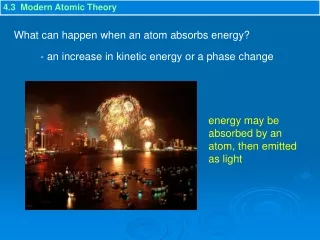
they only light up when they receive energy (from the flame or electricity); but why??? • perhaps the atoms are getting excited by absorbing the E • when they release that same amount of E they give off in the form of light
here Li is giving off a photon of reddish light; Cu would give off green, sodium yellow • but, again, why? • somehow they give off the exact amount of E they received and are happier b/c of it
11.4 the energy levels of hydrogen • Recall: an atom with excess E is said to be excited • When it emits the photon it goes back to unexcited state called ground state • Now we look specifically at hydrogen, but remember: different wavelengths carry different amounts of Energy per photon…
another way to look at it… • Important point! The Energy contained in the photon corresponds exactly to the DE that the atom experiences
big person time:when we put a load of Energy into a H sample, and look at the light produced, only certain wavelengths shine through H2 Spectrum
i.e. only certain photons are made, no more, no less • why?! • there must be more than one energy level!
notice that the colorof the photon is related to how much E was given off
Big picture for H? The different wavelengths mean there must be several ways for the e- to get back to ground state!
That H has only certain allowed ways for the electron to return to ground means the energy levels are not continuous (a),but quantized (b) • kinda like…
one can “exist” anywhere on the ramp, but only in certain, discrete places on the stairs
11.5 the bohr model of the atom • In 1911 Niels Bohr gave us a model of the atom that is still taught in schools • He pictured it as a nucleus with electrons orbiting like planets around the sun…
The e only orbit the nucleus in certain orbits • When the e- gained Energy it went up to a higher level • When it gave off its E it fell back down, giving off a photon in the process • this actually worked well for H, but…
It didn’t work for any other atom :( • In fact, it turns out e- don’t move around the atom like planets, either :( • Despite the fact that it seemed nice and elegant, a better model for the atom was needed…
11.6 the wave mechanical model of the atom • We needed a radical new approach to looking at the atom • By the mid-1920’s that would happen…
Louis de Broglie and Erwin Schrödinger said maybe we should look at the electron not as a particle but as a wave! • Schrödinger even developed an equation to describe what the wave-electron was doing • his equation worked! and not just for H, but for all atoms • called wave mechanical model of the atom…
here the electrons exist in orbitals, they do not move in orbits • from the firefly exp in your book, the photograph will look like this • the likelihood of seeing the firefly flash is best near the center, worse farther away • you can never be sure where it is, just where it might be
According to the wave-mechanical model, the H e-’s lowest Energy can be pictured like this • Schrödinger found that he could not tell exactly where the e- was or where it was going, only where it probably is • But wait! there’s more…
11.7 the hydrogen orbitals • The fuzzy drawing we see here just represents where the electron probably is • It’s easier to draw it as a sphere, which represents the volume in space where there is a 90% chance of finding the little critter
This orbital has a name: 1s • It is hydrogen’s lowest energy state • What happens when the e- goes into an excited state? • first…
Hydrogen energy levels • Remember that the H atom has discrete E levels? They have a name… • = principal energy levels • Labeled by integers from n = 1 n = • Each level has sublevels, like rooms on a floor
Can be pictured like this: • see a pattern?
The lowest level (ground state) contains just one orbital; the 1s • 1 stands for the 1st principal quantum level • s is the abbreviation for the sublevel that is there and tells us its shape (spherical)
the 2s is just like the 1s, but bigger • but the 2p’s are entirely different…
There are three of them and they are dumbbell shaped (lobed) • The x, y, and z tells us which axis they are lined up on • (note: these are single orbitals with double lobes)
The three 2p Orbitals The 2px orbital The 2py orbital The 2pz orbital
If overlapped they look like this(this view will play a big role beyond H)
Important to note that as level number goes up so does average distance from nucleus • So if H has only one e- why does it have so many orbitals?…
Hydrogen orbitals • The extra orbitals are just potential orbitals for an excited e- • The e- can only only occupy one space at a time! • but wait! there’s more!…
At level 3 there are s and p orbitals just like the previous levels - only bigger • but wait! there’s more!
There is room for even more orbitalsout there • there are d orbitals!
The shapes and labels of the five 3d orbitals The 3dxz orbital The 3dyz orbital The 3dxy orbital The 3dz2 orbital The 3dx2z2 orbital