
Effects of CFCs on Ozone Depletion: Reactions and Consequences
This document presents crucial information on the harmful reactions involving chlorofluorocarbons (CFCs) and ozone in the atmosphere. CFCs are stable and can persist in the environment, slowly rising to the stratosphere. Once there, UV radiation breaks down CFCs, releasing chlorine radicals (Cl•) that facilitate the destruction of ozone (O3). The sequence of reactions shows how a single Cl• radical can catalyze the breakdown of numerous ozone molecules, leading to significant depletion within the stratosphere. Understanding this process is vital for addressing ozone layer depletion.

Effects of CFCs on Ozone Depletion: Reactions and Consequences
E N D
Presentation Transcript
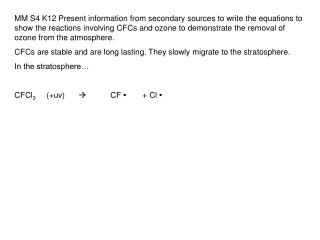
MM S4 K12 Present information from secondary sources to write the equations to show the reactions involving CFCs and ozone to demonstrate the removal of ozone from the atmosphere. CFCs are stable and are long lasting. They slowly migrate to the stratosphere. In the stratosphere… CFCl3 (+uv) CF • + Cl •
MM S4 K12 Present information from secondary sources to write the equations to show the reactions involving CFCs and ozone to demonstrate the removal of ozone from the atmosphere. Once the chlorine radical has been generated Cl• + O3 ClO • + O2 ClO • + O • Cl • + O2 O3 + O • 2O2
MM S4 K12 Present information from secondary sources to write the equations to show the reactions involving CFCs and ozone to demonstrate the removal of ozone from the atmosphere. It seems like that’s it….. but no, wait.. What’s this?
MM S4 K12 Present information from secondary sources to write the equations to show the reactions involving CFCs and ozone to demonstrate the removal of ozone from the atmosphere. Once the chlorine radical has been generated Cl• + O3 ClO • + O2 ClO • + O • Cl • + O2 Disaster.. It happens again
MM S4 K12 Present information from secondary sources to write the equations to show the reactions involving CFCs and ozone to demonstrate the removal of ozone from the atmosphere. Once the chlorine radical has been generated Cl• + O3 ClO • + O2 ClO • + O • Cl • + O2 And again
MM S4 K12 Present information from secondary sources to write the equations to show the reactions involving CFCs and ozone to demonstrate the removal of ozone from the atmosphere. Once the chlorine radical has been generated Cl• + O3 ClO • + O2 ClO • + O • Cl • + O2
MM S4 K12 Present information from secondary sources to write the equations to show the reactions involving CFCs and ozone to demonstrate the removal of ozone from the atmosphere. Once the chlorine radical has been generated Cl• + O3 ClO • + O2 ClO • + O • Cl • + O2 And again. For about 100,000 times for every Cl • radical The net result is the destruction of huge amounts of ozone in the stratosphere because the chlorine radical is regenerated and acts as a catalyst.