Understanding Network Firewalls: Security Strategies and Challenges
This insightful presentation by John Kristoff from DePaul University explores the evolving role of network firewalls in cybersecurity. It discusses how firewalls serve as a gateway to manage traffic between trusted and untrusted zones, highlighting techniques like packet filtering, proxy firewalls, and stateful inspection. The talk raises critical questions about the effectiveness of current firewall solutions and emphasizes the need for a holistic approach to security, including auditing, user education, and best practices. Gain insights into firewall functionalities, their limitations, and the future of network security.

Understanding Network Firewalls: Security Strategies and Challenges
E N D
Presentation Transcript
Network Firewalls • John Kristoff • jtk@depaul.edu • +1 312 362-5878 • DePaul University • Chicago, IL 60604
The network is just a highway • How do you secure the highway • Police patrol • Toll booths • Licensed drivers • Vehicle inspections and standards • Rules of the road • Are the highways completely safe now?
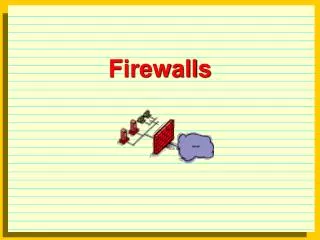
What network firewalls do • Define untrusted and trusted boundaries • Inspect traffic traversing firewall boundary • Limit communication traversing boundary • Help shield insecure hosts
Key ideas • Firewalls should be unnecessary • They're a network solution to a host problem • They don't solve the real problem and... • ..make it hard/impossible to do certain things • Ultimate control of hosts is out of our hands • Securing a LOT of hosts is hard! • But.. network solutions are *sigh* necessary
Packet filtering firewalls • Filter everything - not very useful • Filter by IP address • Filter by application type (TCP, UDP) • Filter on field/flag settings (source route) • Filter invalid packets (SYN/FIN packets) • Other pattern match
Application Layer Gateway (ALG) • Also commonly called a proxy firewall • These permit no direct communication • Firewall intercepts all traffic in each direction • Very intelligent device... • ...must understand what a user is doing • Difficult to install if it doesn't currently exist
Other common firewall features • Stateful inspection • Network address translation (NAT) • Authenticaton (VPNs) • Dynamic triggers • Reporting, logging and IDS support
What can't a network firewall stop? • Bad packets that look good • Denial of service (DoS) attacks • Well, they can stop them at the firewall • But then the firewall has just been DoS'd • Stupid user tricks • Things that go around the firewall • Things that don't cross the firewall boundary
So you're saying...? • It would be nice if all hosts could be secured • Network solutions can help • Malicious insiders can get by anything you got • A holistic approach is needed. Including: • Audits, detection and response • Education • Standards and best practices
What does DePaul do? • We stop some obvious stuff in various places • We're beginning to do more at the edges • Note: the network will be very fast soon... • ...big firewalls get in the way big time • Regardless of what you may have heard... • We're better off than we were 2 years ago • Of course so are the attackers
Final thoughts • Overly secure systems are not at all useful • Big border firewalls are obsolescent • Distributed firewalls are getting a lot of talk • Firewall vendors of course like this approach • You should demand open AND secure access • We can do it, but it ain't gonna easy • If we fail, the Internet will become very boring
References http://networks.depaul.edu/security/ http://condor.depaul.edu/~jkristof/ news://news.depaul.edu/dpu.security http://www.cert.org http://www.sans.org http://www.cerias.purdue.edu http://www.neohapsis.com http://www.lists.gnac.net/firewalls/ http://www.interhack.net/pubs/fwfaq/