Download
1 / 43
430 likes | 537 Views
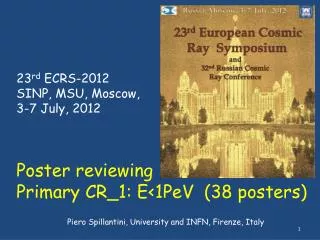
23 rd ECRS-2012 SINP, MSU, Moscow, 3-7 July, 2012. Poster reviewing Primary CR_1: E<1PeV (38 posters). Piero Spillantini, University and INFN, Firenze, Italy. Outline. 1) Data and data analysis with Pamela pcr_1_353,383,452,473,477,641,643,659

E N D
23rd ECRS-2012 SINP, MSU, Moscow, 3-7 July, 2012 Poster reviewing Primary CR_1: E<1PeV (38 posters) Piero Spillantini, University and INFN, Firenze, Italy
Outline 1) Data and data analysis with Pamelapcr_1_353,383,452,473,477,641,643,659 with ARGO-YBJpcr_1_389,476 with ATIC-2 pcr_1_456 with Doch-4A pcr_1_536,537 with Carpet-2 pcr_1_576 ‘Fractionally charged’ pcr_1_733 2) Instruments and methods New project pcr_1_319, Prototypespcr_1_527, 544, 556 Statuspcr_1_391,538 New methods cr_1_541,549,623,627,638,723,724 3) Theory and Phenomenology pcr_1_165,184,196,464,516,518,571,665
Data and data analysis: PAMELA
353 • stand-alone trigger in calorimeter GF: 20 600 cm2sr 3000 ev in 5y • reconstruction by multistep fitting • isotropy map creation (5°x5°)
383 • Work in progress on identification capability for light nuclei isotopes with multiple de/dx in cal. • expect provide new data of 6Li, 7Li, 7Be and 9Be, separation 9Be-10Be seems possible
452 et al. • DRD model fit better e+ flux at low energies • PD and DR models fail to describe data
473 TOF stand-alone Calorimeter stand-alone Slow-down effect
477 • Improvements of the d identification enhanced p suppression + decrease systematics • improvements: truncated mean values of de/dx in tracker + added de/dx in 6 TOF counters
641 • PAMELA covers full sky search for global anisotropies possible • search at large scale anisotropies (30°-90°) for e- and e+ with E>40 GeV + around SUN direction • preliminary: arrival directions consistent with isotropic expectation
643 • L-shell 1.12-1.5 available for PAMELA, peak of pitch-angular distribution is narrow • angular resolution <4°, e>60 MeV, 5 year statistics • measured quasitrapped on boundary of rad belts ane HE (>1GeV) trapped and quasi-trapped • - result: p, e-, e+ local and equatorial pitch-angular distributions
659 • Antip selection with Multivariate analysis • increased statistics (2800 antip) and energy range
Data and data analysis: other
389 • Data with zenith<15° and core in 40x40 m2, correlation with pressure and temperature • CR generated in 100 GeV-4PeV, shower simulated by CORSIKA • medium energy p 4.5-56 TeV, He 9-90 TeV
Arrival direction information on source distribution + propagation medium + diffusion • anisotropy 10-4-10-3 in TeV CR arrival direction in angular scalea 10°-180° • new details of CR distribution in 10°-70°
456 (Z=16-24)/Fe (Ti+V+Cr)/Fe • Upturn can be understood with CG+B (B: bubble with embedded sources) model • Upturn near 200-300 GeV/n predicted but index 2.5
536 -Continous operation of ‘Doch-4M,A’ could not reproduce ‘Erzions’ found in Doch-4 in 1999 - many material used to convert neutral Erzions in charged detectable Erzions - New device used in 2012 once was not able to reproduce previous results
733 - In Aragats a group of 4e/3 charge events with HE (>80GeV) - In ATIC-2 ‘additional events’ with ionization 0.53 of proton
Projects, instruments, New methods
Prototype of PRISMA project, run on the NEVOD basis • 32 new type ‘en.detectors’ sensitive to em component and hadrons (through thermal n). • thin inorganic scintillator (ZnS(Ag) + LiF enriched with 6Li) sensitive to thermal n (fast • response, 50 photoelectron per n-capture) • - Seeking EAS core position, size (Nn) and age (using em component)
540 156.5 TASC - FEC PD 540 SIA+TID SIA 120 Electronics Electronics 448 448 240 IMC IMC IMC - - - FEC FEC FEC 32 32 32 IMC 156.5 20 MAPMT MAPMT MAPMT TASC - FEC PD 95 95 95 TASC 240 20 100 100 320 320 712 712 319 Mass 650 kg Power 650 W Launch date FY 2014 Launch carrier HTV-5 Acceptance: 0.12 m2sr e, p-Fe 0.10 gammas 0.40 ultra heavy nuclei Energy resolution: 2% e, gammas @ E>100 GeV 40% p @ 1TeV 30% nuclei @ 50 GeV/n Angular resolution <1° Charge resolution 0.15-0.30 for Z=2-26 e/p rejection power 105 • - Can identify possible signatures from nearly SNRs (e.g. Vela) in e spectrum • Has the potential to detect e and gamma signals from dark matter annihilation/decay • With excellent energy resolution 2% • Can measure the spectra of individual elements in CRs with unprecedented accuracy • Approaching the ‘knee’ region • Ultra heavy nuclei up to Z=40 in 5 y • B/C up to 5TeV/n (5y)
544 • Low/moderate solar activity in June 2011: used to investigate response large modular CR det. • smart design: assembling new CR monitors with He counters in different length • registered intensity well accounts for the macro prturbations in near Earth Space
556 • New kind of track-pits, with specific pit-form and very small size • CN-85 exposed on satellite in 1995 • considered very short (<3mm) tracks (solar protons and stopping recoil nuclei) • from layer-to-layer investigation: a three of pit swarm correlated with the end • of the track formed by high ionizinf primary charged particles (stopping of • oegative charged Herzions?)
391 Deployed on ISS and taking data from May 2011 - tracker: expected behavior, stable on temperature, pedestals, noise
538 • 3 well known counters BP28 + 12 new model LND2061 • Preliminary: the two types are compatible • New acquisition board used
541 • Study of EAS offers a unique way to extract p-air interaction cross section • Pointed out some limitation of standard technique • New approach involving simultaneous measurement of absorption of EAS • and attenuation of electron component is proposed
638 (n) (p) - GEANT4 simulation framework PLANETOCOSMICS - Good agreement with Data
724 • - One half of p events had no track in the EC • New geometrical reconstruction tested on ¼ of events • Both methods give the same result • An unknown component could be present in the primary particle flux • Processing of additional events necessary to obtain significant data
165 Hig energy neutrons used for investigating gas and dust in Kuiper belt
184 Antip and antin -Atmosf. Antip and antin (5-300 g/cm2) by CORSIKA - Hadronic interactions SYBILL & FLUKA - Match well BESS-2001 in 1-3GeV
464 464 • -First order Fermi diffuse shock acceleration unifying factor production HE particles • Differential index determined by Mach number (2.5 for CR) • Knee due to decreasing number of sources for >1014 eV • Spectrum calculated by solving first-order Fredhom equation comprising convolution • of first Fermi equation with increasing particle rigidity
516 • Fractional diffusion model to describe propagation from sources • e- and e+ injected by sma sources wityh same index (2.85) • e+/e increases to 0.22 for >100GeV
518 • Proposed an Anomalous Diffusion (AD) model for solving the ‘knee’ problem • Anomaly from large paths length between magnetic domains • Contribution r<1kpc and t<105 y sources defines spectrum and provide knee • Behavior of H/He observed by PAMELA reproduced An
571 • Proposed an Anomalous Diffusion (AD) model for solving the ‘knee’ problem • Simulationof random walk processes in one-dimensional case • p(r) distribution from MC agrees with analitical solution (fig.1) • p(r) at different times • Finitness of velocity on shape is neglegible