Download
1 / 11
110 likes | 222 Views
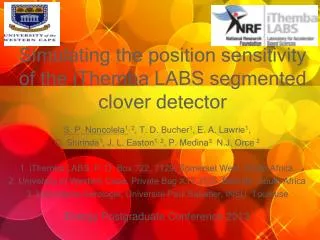
This project focuses on determining the position sensitivity of the iThemba LABS segmented clover detector by analyzing pulse shapes from interactions at various positions. We utilize pulse shape analysis by comparing measured pulses with simulated reference data to evaluate the gamma-ray tracking capabilities of the detector. Our findings include insights on resolving interaction points at different radii and angles, and the sensitivity to depth variations. Future plans involve building a comprehensive database of simulated pulse data for comparison with experimental results.

E N D
Simulating the position sensitivity of the iThemba LABS segmented clover detector S. P. Noncolela1, 2, T. D. Bucher1, E. A. Lawrie1, O. Shirinda1, J. L. Easton1, 2, P. Medina3 N.J. Orce 2 1. iThemba LABS, P. O. Box 722, 7129, Somerset West, South Africa. 2. University of Western Cape, Private Bag X17,7535, Bellville, South Africa 3. Laboratoire Aerologie, Universite Paul Sabatier, INSU, Toulouse Energy Postgraduate Conference 2013
Aim of the project • To determine the position sensitivity of our detector using the shape of the core and segments pulses. • Pulse shape analysis method compares the shape of a set of measured pulses with a corresponding set of pulses from a simulated reference database. • To evaluate the gamma-ray tracking capability of the iThemba LABS segmented clover detector. • To develop expertise in iThemba LABS on gamma spectroscopy using advanced gamma-ray tracking detectors.
Core and segment pulses at different radii Core Hit segment
Core and segment pulses at different angles Core Segments, 35⁰ Segments, 55⁰ Segments, 70⁰
Conclusions and Future plans • Pulse shapes have been simulated at different positions (radii, azimuthal angle and depth) within the detector volume. • For interaction points at different radii – the shape of the pulses at the inner contact can be used to resolve the positions. • For different azimuthal angles- the induced signal at the neighbouring segments are important in determining the position. • For different depths- there are positions for which the depth can be determined, but the detector seem to be less sensitive to some parts of the detector especially for interactions at the back of the detector. • Realistic simulations: pulse + preamp + electronics + cross talk • Build database of simulated pulses • Compare with experimental pulses • Simulating more than one interaction • Compton scattering between 2 segments • Compton scattering inside one segment