Download
1 / 11
110 likes | 217 Views
Learn about symptoms of major depressive and manic episodes, as well as unipolar mood disorders. Discover various treatments, from medications to therapy, that can help manage these conditions effectively.

E N D
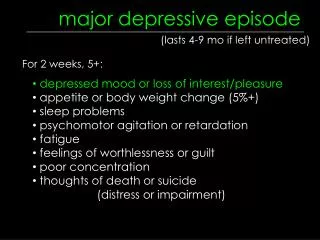
major depressive episode (lasts 4-9 mo if left untreated) For 2 weeks, 5+: • depressed mood or loss of interest/pleasure • appetite or body weight change (5%+) • sleep problems • psychomotor agitation or retardation • fatigue • feelings of worthlessness or guilt • poor concentration • thoughts of death or suicide • (distress or impairment)
manic episode (lasts 3-6 mo if untreated) 1 week of elevated, expansive, or irritable mood and 3+: • inflated self-esteem/grandiosity • less need for sleep • excessively talkative • racing thoughts • too easily distracted • increased goal-directed activity/ psychomotor agitation • excessive pleasurable but risky activities
mixed manic episode Meets criteria for both major depressive episode & manic episode. hypomanic episode Less severe than mania & does not cause impairment (at least 4 days)
unipolar mood disorder Major Depressive Disorder, single episode (rare!) Major Depressive Disorder, recurrent dysthymic disorder 2+ years depressed mood, more days than not double depression dysthymic disorder + major depressive episode
bereavement Less than 2 mo of grief over death of loved one impacted grief reaction extreme bereavement w/psychosis
the following are all chronic w/ poor prognosis bipolar I disorder a manic episode bipolar II disorder hypomanic episode + major depressive episode cyclothymic disorder 2+ years alternating dysthymia & hypomania rapid cycling?
theories for cause BIOLOGICAL VULNERABILITY Genetic liability for emotional disorders (dep, anx) Low serotonin allows NE & DA to range widely. Which disorder? GENERAL PSYCHOLOGICAL VULNERABILITY Depends on experiences. Negative attributional style (uncontrollability). ANXIETY DEPRESSION Uncertain of control. Gives up hope. STRESSORS TRIGGER ONSET Kindling effect, reciprocal-gene environment
antidepressant meds TRICYCLICS – downregulates receptors MAO-Is (tyramine & the cheese effect) SSRIs
mood stabilizers LITHIUM (therapeutic vs. lethal dosage window) -kidney dysfunction & seizures ANTICONVULSANTS (valproate, carbamazepine) - Less effective than lithium for suicide
ECT 65-140 volts for half second produces seizure for 30 secs to few minutes. Applied 3x/week for 4 weeks. TMS Daily for 2-4 weeks to PFC. But produces seizures so not yet FDA approved.
CBT therapy behavior therapy • stop social avoidance behavior, confront & cope with feared social cues • increase exercise interpersonal psychotherapy Work on interpersonal disputes, loss of relationships, gain new relationships, & increase social skills