Download
1 / 3
30 likes | 137 Views
Paul Evenson and John Clem from the University of Delaware's Department of Physics and Astronomy present a comprehensive overview of Low Energy Electron (LEE) research and its historical context. For decades, LEE has served as a cosmic ray electron "standard candle." This presentation discusses time profiles of helium and electron observations at a rigidity of 1.2 GV, the impact of solar magnetic polarity, and the drift model modulation calculations. Insights into current LEE flights and future prospects, such as PAMELA and AMS interactions, are key highlights.

E N D
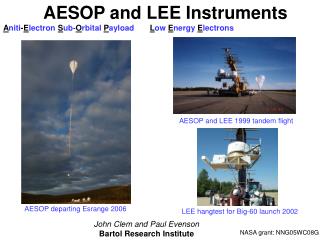
Low Energy Electron Observations (LEE, AESOP and the Historical Context) Paul Evenson and John Clem University of Delaware Department of Physics and Astronomy Bartol Research Institute
For Decades LEE has been the Cosmic Ray Electron “Standard Candle” Magnetic Polarity • Time profile of helium and electron observations at a rigidity of 1.2 GV • Alternation with solar magnetic polarity is probably due to “drifting” across magnetic field lines • Large symbols are LEE flights, others are spacecraft “calibrated” by LEE • LEE 2009 is now beeing prepared in Kiruna • We hope PAMELA is next
Present Status of Positron Observations and Theory • New “drift model” modulation calculation with a flat current sheet for two diffusion coefficients can reproduce AMS or PAMELA but not both