Coupling Atomic and Continuum Scales: Balance Laws and Basis Sets
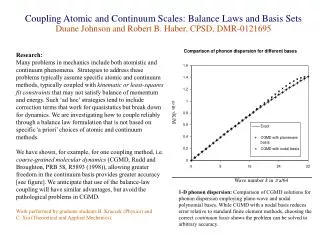
This research investigates the coupling of atomic and continuum phenomena in mechanics. Traditional strategies often rely on specific atomic and continuum methods that fail to ensure balance laws for momentum and energy. Our approach formulates coupling through balance laws, avoiding the limitations of ad hoc strategies. We've demonstrated that greater freedom in continuum basis improves accuracy, particularly in the context of coarse-grained molecular dynamics (CGMD). This study reveals that choosing the appropriate continuum basis can enhance the precision of the solutions significantly, making them applicable for dynamic problems.

Coupling Atomic and Continuum Scales: Balance Laws and Basis Sets
E N D
Presentation Transcript
w in √K/M Wave number k in p a/64 Coupling Atomic and Continuum Scales: Balance Laws and Basis SetsDuane Johnson and Robert B. Haber, CPSD, DMR-0121695 Research: Many problems in mechanics include both atomistic and continuum phenomena. Strategies to address these problems typically assume specific atomic and continuum methods, typically coupled with kinematic or least-squares fit constraints that may not satisfy balance of momentum and energy. Such ‘ad hoc’ strategies tend to include correction terms that work for quasistatics but break down for dynamics. We are investigating how to couple reliably through a balance law formulation that is not based on specific 'a priori’ choices of atomic and continuum methods. We have shown, for example, for one coupling method, i.e. coarse-grained molecular dynamics (CGMD, Rudd and Broughton, PRB 58, R5893 (1998)), allowing greater freedom in the continuum basis provides greater accuracy [see figure]. We anticipate that use of the balance-law coupling will have similar advantages, but avoid the pathological problems in CGMD. Work performed by graduate students B. Kraczek (Physics) and C. Xia (Theoretical and Applied Mechanics). crack growth 1-D phonon dispersion: Comparison of CGMD solutions for phonon dispersion employing plane-wave and nodal polynomial bases. While CGMD with a nodal basis reduces error relative to standard finite element methods, choosing the correct continuum basis shows the problem can be solved to arbitrary accuracy.