1 / 6

Lecture 17 Don DeVoretz

Learn about Current Account and Capital Account in the balance of payments system, including factors such as exports, imports, investment income, debt service, remittances, and capital flows. Explore how the equilibrium is maintained and what happens in case of a lack of cash reserves. Discover borrowing options from private banks, bilateral government loans from countries like Japan, USA, and the EU, and multilateral sources like the Inter-American Bank and IMF.

wattan
Download Presentation

Lecture 17 Don DeVoretz

An Image/Link below is provided (as is) to download presentation Download Policy: Content on the Website is provided to you AS IS for your information and personal use and may not be sold / licensed / shared on other websites without getting consent from its author. Content is provided to you AS IS for your information and personal use only. Download presentation by click this link. While downloading, if for some reason you are not able to download a presentation, the publisher may have deleted the file from their server. During download, if you can't get a presentation, the file might be deleted by the publisher.

E N D

Presentation Transcript


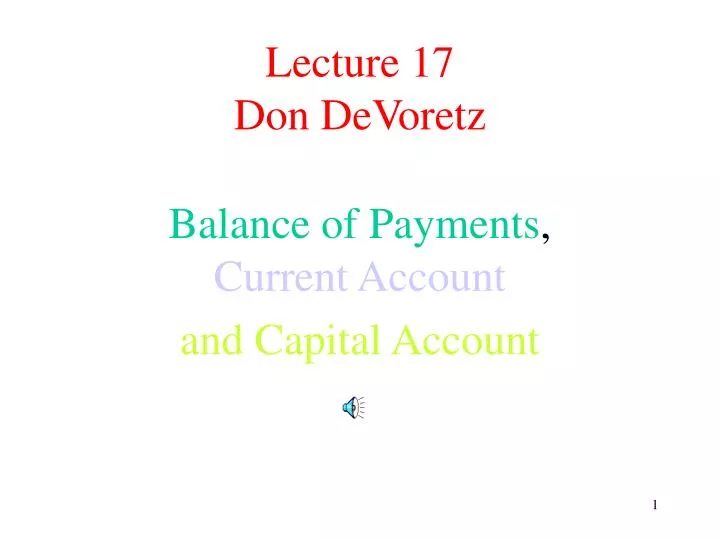
  1. Lecture 17Don DeVoretz Balance of Payments, Current Account and Capital Account

  2. Current Account: • 1. Exports of goods and Services = A • 2. Imports of G and S = B • 3. Investment Income = C • 4. Debt Service = D • 5. Remittances = E • Current Account = (A-B+C-D+E) < or > than 0

  3. Capital Account • 6. Direct Private Investment =G • 7. Foreign Loans = H • 8. Foreign Assets Domestic Banks = I • 9. Capital Outflow =K • Capital Account= (G+H-I-K)

  4. Equilibrium: Balance of Payments • +/- Cash Reserves = • Current Plus • Capital Account • What if no CASH Reserves in hard currency ? • BORROW

  5. From Whom ? • Private Banks: BNS • Bilateral Gov’t Loans • Japan,USA and EU • Multilateral • Inter-American Bank • IMF
  6. End of Show

More Related