Understanding Solutions: Types, Properties, and Dissolving Processes in Chemistry
This resource explores the fundamental concepts of solutions in chemistry, discussing the nature of homogeneous mixtures including solutes and solvents. It covers suspension and colloidal systems, the characteristics of electrolytes and nonelectrolytes, and the processes governing dissolution. Key concepts like saturation (saturated, unsaturated, supersaturated), molarity calculations, dissociation of ionic compounds, and colligative properties are explained. Understanding these principles is critical for mastering solution chemistry and its practical applications in laboratory settings.

Understanding Solutions: Types, Properties, and Dissolving Processes in Chemistry
E N D
Presentation Transcript
Solutions Chapters 13 & 14
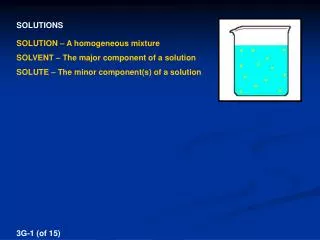
What is a solution? • Homogeneous mixture • Solute – what gets dissolved • Solvent – what does the dissolving • Suspensions – solute particles are so big they settle out (must be shaken) • Colloid – solute particles are large, but do not settle • Refer to table 13-1 for solution types (p. 396)
Electrolytes • Solutions that conduct electricity • Solutes must ionize (break apart into ions when dissolved) ex. NaCl • Neutral solutes are nonelectrolytes, ex. sugar
The solution process • Heat, motion, size of solute – help solid dissolve in a liquid (think kool-aid) • Lack of heat, lack of motion and increase in pressure – help gas dissolve in a liquid (think soda pop)
Saturation • Saturated – solution contains the most solute it can hold at a particular temperature • Unsaturated – solution can hold more solute • Supersaturated – solution is heated, maximum solute is dissolved and then solution is cooled so that excess solute remains dissolved
Dissolving Rules • Like dissolves like • Polar solvents will ONLY dissolve polar solutes • Nonpolar solvents will ONLY dissolve nonpolar solutes
Molarity • Number of moles of solute per liter of solvent (mol/L) • Need to know molar mass of solute and amount of solvent in liters • Convert mass of solute to moles of solute using molar mass. Then divide by volume amount.
Example You have 3.50 L of solution that contains 90.0 g of NaCl. What is the molarity?
Example You need to make 500. mL of 4.00 molar H2SO4. How much sulfuric acid do you need?
Dissociation • When an ionic compound is dissolved it separates into ions • Remember an ionic compound is made of a metal bonded to a nonmetal CaCl2 Ca+2 + 2Cl-
Precipitates • Insoluble solid that is formed when two liquids react in a double replacement reaction • Solubility rules on p. 427 (do not need to memorize, but do need to know how to use)
Net Ionic Equations (NH4)2S + Cd(NO3)2 2 NH4NO3 + CdS 2 NH4+ + S-2 + Cd+2 + 2 NO3- 2 NH4+ + 2 NO3- + CdS S-2 + Cd+2 CdS Spectator Ions: NH4+ & NO3-
Colligative Properties • Properties that depend on the amount of solute present • Dissolved solutes lower the freezing point and raise the boiling point of water