Download
1 / 4
40 likes | 166 Views
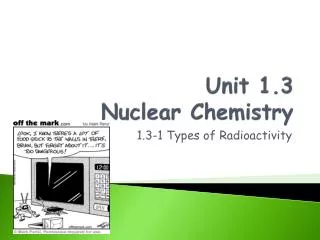
This guide explores how chemists write nuclear equations and the essential rules governing them. Key concepts covered include transmutation and radioactive decay, explaining how elements transform through the emission of alpha or beta particles and positrons. The importance of balancing atomic mass and charge in nuclear equations is emphasized, along with an exploration of why some elements undergo radioactive decay while others do not. The document also includes housekeeping agendas for classroom management and essential questions to deepen student understanding of nuclear chemistry.

E N D
Aim: How do chemists write nuclear equations? (and “housekeeping”) Do Now: Copy vocabulary: Transmutation- When an element changes into another element by undergoing radioactive decay; Table N Radioactive decay: When elements lose high energy alpha or beta particles, or emit positrons; Table O Rules for writing nuclear equations: Masses on each side of the equation must equal. Charges on each side of the equation must equal. The nuclear chargeis the atomic number, and can be used to identify any new elements that form.
Aim: How do chemists write nuclear equations? (and “housekeeping”)Writing nuclear equations: http://www.evanschemistrycorner.com/WS/NuclearWS/WS121a_Writing_Nuclear_Equations.pdf
Aim: How do chemists write nuclear equations? (and “housekeeping”) Essential Questions: • Why do certain elements undergo radioactive decay and others don’t? • How do the nuclei of atoms stay intact if protons are positive, and like charges repel? • Describe the various types of radioactive decay in terms of charge, mass and “penetrating power.”
Aim: How do chemists write nuclearequations? (and “housekeeping”) Housekeeping agenda: • Ms. Osorio will return hw, labs, and class work. • Students who missed atomic structure exam given last week will take it today. • Bulletin board- students can put up exemplary work. • Students can submit missing work for Cycle 2.