Download
1 / 6
60 likes | 180 Views
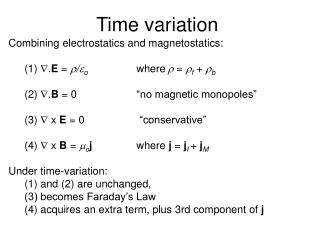
This document presents the latest progress in the study of time variation and modal noise within IEEE 802.3aq channel models. Key findings include the establishment of a standard link for modeling, vibration tests conducted at various frequencies in office environments, and initial experiments to determine the relationship between perturbation spectrum and modal noise spectrum. The study investigates temperature effects and compiles a comprehensive list of mechanisms impacting channel variance. Ongoing modal noise calculations and experimental setups are detailed, aiming to enhance understanding of signal integrity.

E N D
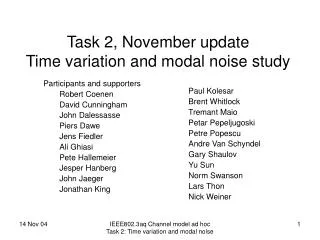
Task 2 update: Time variation and modal noise study IEEE802.3aq Channel model ad hocTask 2: Time variation and modal noise
Task 2 Progress To date: • 'Standard link' for modeling and experiments agreed • 4 connectors with 2 connectors at 7micron offset (worst case consistent with preceding standards and existing link specs) • Adopted GR-63-CORE describing in-building environments • office environment vibration tests at 'constant acceleration' (0.1G & 1G) from 5-100 Hz (vibration amplitude ~ 1/f2) Active: • Experiments to determine relationship of perturbation spectrum to modal noise spectrum just started. Initial experiments at 10-100Hz, 3-5mm p-p movement • up to 3x frequency multiplication observed • Study of temperature effects in progress • Comprehensive list of mechanisms compiled and size of each effect being determined. Most significant effects will be for further study • Modal Noise calculations in progress • not likely to be ready for September interim IEEE802.3aq Channel model ad hocTask 2: Time variation and modal noise
Standard link: Agreed worst-case test configuration for channel variance measurements from '62 MMF con loss and draft worst case configuration' - David Cunningham IEEE802.3aq Channel model ad hocTask 2: Time variation and modal noise
Vibration tests representative of office environment • GR 63 CORE • describes office environment vibration tests at 'constant acceleration' (0.1G & 1G) from 5-100 Hz • (vibration amplitude ~ 1/f2 ) • Perturbation to be applied to 10m fibre loop prior to main MM fibre • 0.1G acceleration at 1Hz corresponds to a 2.5cm perturbation amplitude - similar to TIA/EIA-455-203 fibre shaker • 1G acceleration at 1Hz corresponds to 25cm amplitude - similar to 'shaking the fibre' from summary of GR-63-CORE in 'LRM080404' - John Dellasasse IEEE802.3aq Channel model ad hocTask 2: Time variation and modal noise
Summary table of temperature variation impact from Sept 15th rev of 'Temperature variation' - Petre Popescu IEEE802.3aq Channel model ad hocTask 2: Time variation and modal noise
Experimental study of channel variation vs perturbation frequency • Experimental test set up and intitial results are described in document: 'TimevarianceinMMFlinks-initialtestresults' - Robert Coenen IEEE802.3aq Channel model ad hocTask 2: Time variation and modal noise