Type Inference
This document explores type inference in programming languages, highlighting its critical role in managing type constraints, polymorphism, and code reuse. It discusses the advantages and criticisms of typed languages, focusing on how polymorphism enables more generalized code constructs while addressing concerns over productivity and complexity. The methodology includes generating type constraints from unannotated programs, solving these constraints, and ultimately deriving type schemes for functions. Key steps in the type inference process are clearly laid out, providing insight into both theoretical foundations and practical applications.

Type Inference
E N D
Presentation Transcript
Type Inference Edited version of notes by Dave Walker@ Princeton who in turn edited notes by Bob Harper@CMU Both Dave and Bob were grad students at Cornell, so I decided it was OK to borrow their work…
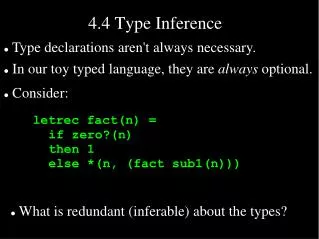
Criticisms of Typed Languages • Types overly constrain functions & data • polymorphism makes typed constructs useful in more contexts • universal polymorphism => code reuse • existential polymorphism => rep. independence • subtyping => coming soon • Types clutter programs and slow down programmer productivity • type inference • uninformative annotations may be omitted
Type Inference • Today • overview • generation of type constraints from unannotated simply-typed programs • solving type constraints
Type Schemes • A type scheme contains type variables that may be filled in during type inference • s ::= a | int | bool | s1 -> s2 • A term scheme is a term that contains type schemes rather than proper types • e ::= ... | fun f (x:s1) : s2 is e end
Example fun map (f, l) is if null (l) then nil else cons (f (hd l), map (f, tl l))) end
Step 1: Add Type Schemes fun map (f : a, l : b) : c is if null (l) then nil else cons (f (hd l), map (f, tl l))) end type schemes on functions
Step 2: Generate Constraints fun map (f : a, l : b) : c is if null (l) then nil else cons (f (hd l), map (f, tl l))) end b = b’ list
Step 2: Generate Constraints constraints b = b’ list fun map (f : a, l : b) : c is if null (l) then nil else cons (f (hd l), map (f, tl l))) end : d list
Step 2: Generate Constraints constraints b = b’ list fun map (f : a, l : b) : c is if null (l) then nil else cons (f (hd l), map (f, tl l))) end : d list b = b’’’ list b = b’’ list
Step 2: Generate Constraints constraints b = b’ list b = b’’ list b = b’’’ list fun map (f : a, l : b) : c is if null (l) then nil else cons (f (hd l : b’’), map (f, tl l : b’’’ list))) end : d list a = a b = b’’’ list
Step 2: Generate Constraints constraints b = b’ list b = b’’ list b = b’’’ list a = a b = b’’’ list fun map (f : a, l : b) : c is if null (l) then nil else cons (f (hd l : b’’) : a’, map (f, tl l): c)) end : d list a = b’’ -> a’
Step 2: Generate Constraints constraints b = b’ list b = b’’ list b = b’’’ list a = a b = b’’’ list a = b’’ -> a’ fun map (f : a, l : b) : c is if null (l) then nil else cons (f (hd l : b’’) : a’, map (f, tl l): c)) : c’ list end : d list c = c’ list a’ = c’
Step 2: Generate Constraints constraints b = b’ list b = b’’ list b = b’’’ list a = a b = b’’’ list a = b’’ -> a’ c = c’ list a’ = c’ fun map (f : a, l : b) : c is if null (l) then nil else cons (f (hd l : b’’) : a’, map (f, tl l): c)) : c’ list end : d list d list = c’ list
Step 2: Generate Constraints constraints b = b’ list b = b’’ list b = b’’’ list a = a b = b’’’ list a = b’’ -> a’ c = c’ list a’ = c’ d list = c’ list fun map (f : a, l : b) : c is if null (l) then nil else cons (f (hd l : b’’) : a’, map (f, tl l) : c)) : c’ list : d list end : d list d list = c
Step 2: Generate Constraints final constraints b = b’ list b = b’’ list b = b’’’ list a = a b = b’’’ list a = b’’ -> a’ c = c’ list a’ = c’ d list = c’ list d list = c fun map (f : a, l : b) : c is if null (l) then nil else cons (f (hd l), map (f, tl l))) end
Step 3: Solve Constraints • Constraint solution provides all possible solutions to type scheme annotations on terms final constraints b = b’ list b = b’’ list b = b’’’ list a = a ... map (f : a -> b x : a list) : b list is ... end solution a = b’ -> c’ b = b’ list c = c’ list
Step 4: Generate types • Generate types from type schemes • Option 1: pick an instance of the most general type when we have completed type inference on the entire program • map : (int -> int) -> int list -> int list • Option 2: generate polymorphic types for program parts and continue (polymorphic) type inference • map : All (a,b,c) (a -> b) -> a list -> b list
Type Inference Details • Type constraints are sets of equations between type schemes • q ::= {s11 = s12, ..., sn1 = sn2} • eg: {b = b’ list, a = b -> c}
Constraint Generation • Syntax-directed constraint generation • our algorithm crawls over abstract syntax of untyped expressions and generates • a term scheme • a set of constraints • Algorithm defined as set of inference rules (as always) • G |-- u => e : t, q
Constraint Generation • Simple rules: • G |-- x ==> x : s, { } (if G(x) = s) • G |-- 3 ==> 3 : int, { } (same for other ints) • G |-- true ==> true : bool, { } • G |-- false ==> false : bool, { }
Operators G |-- u1 ==> e1 : t1, q1 G |-- u2 ==> e2 : t2, q2 ------------------------------------------------------------------------ G |-- u1 + u2 ==> e1 + e2 : int, q1 U q2 U {t1 = int, t2 = int} G |-- u1 ==> e1 : t1, q1 G |-- u2 ==> e2 : t2, q2 ------------------------------------------------------------------------ G |-- u1 < u2 ==> e1 + e2 : bool, q1 U q2 U {t1 = int, t2 = int}
If statements G |-- u1 ==> e1 : t1, q1 G |-- u2 ==> e2 : t2, q2 G |-- u3 ==> e3 : t3, q3 ---------------------------------------------------------------- G |-- if u1 then u2 else u3 ==> if e1 then e2 else e3 : a, q1 U q2 U q3 U {t1 = bool, a = t2, a = t3}
Function Application G |-- u1 ==> e1 : t1, q1 G |-- u2 ==> e2 : t2, q2 ---------------------------------------------------------------- G |-- u1 u2==> e1 e2 : a, q1 U q2 U {t1 = t2 -> a}
Function Declaration G, f : a -> b, x : a |-- u ==> e : t, q ---------------------------------------------------------------- G |-- fun f(x) is u end ==> fun f (x : a) : b is e end : a -> b, q U {t = b} (a,b are fresh type variables; not in G, t, q)
Solving Constraints • A solution to a system of type constraints is a substitution S • a function from type variables to types • because some things get simpler, we assume substitutions are defined on all type variables: • S(a) = a (for almost all variables a) • S(a) = s (for some type scheme s) • dom(S) = set of variables s.t. S(a) a
Substitutions • Given a substitution S, we can define a function S* from type schemes (as opposed to type variables) to type schemes: • S*(int) = int • S*(s1 -> s2) = S*(s1) -> S*(s2) • S*(a) = S(a) • Due to laziness, I will write S(s) instead of S*(s)
Composition of Substitutions • Composition (U o S) applies the substitution S and then applies the substitution U: • (U o S)(a) = U(S(a)) • We will need to compare substitutions • T <= S if T is “more specific” than S • T <= S if T is “less general” than S • Formally: T <= S if and only if T = U o S for some U
Composition of Substitutions • Examples: • example 1: any substitution is less general than the identity substitution I: • S <= I because S = S o I • example 2: • S(a) = int, S(b) = c -> c • T(a) = int, T(b) = int -> int, T(c) = int • we conclude: T <= S • if T(a) = int, T(b) = int -> bool then T is unrelated to S (neither more nor less general)
Solving a Constraint • S |= q if S is a solution to the constraints q S(s1) = S(s2) S |= q ----------------------------------- S |= {s1 = s2} U q ---------- S |= { } a solution to an equation is a substitution that makes left and right sides equal any substitution is a solution for the empty set of constraints
Most General Solutions • S is the principal (most general) solution of a constraint q if • S |= q (it is a solution) • if T |= q then T <= S (it is the most general one) • Lemma: If q has a solution, then it has a most general one • We care about principal solutions since they will give us the most general types for terms
Examples • Example 1 • q = {a=int, b=a} • principal solution S:
Examples • Example 1 • q = {a=int, b=a} • principal solution S: • S(a) = S(b) = int • S(c) = c (for all c other than a,b)
Examples • Example 2 • q = {a=int, b=a, b=bool} • principal solution S:
Examples • Example 2 • q = {a=int, b=a, b=bool} • principal solution S: • does not exist (there is no solution to q)
principal solutions • principal solutions give rise to most general reconstruction of typing information for a term: • fun f(x:a):a = x • is a most general reconstruction • fun f(x:int):int = x • is not
Unification • Unification: An algorithm that provides the principal solution to a set of constraints (if one exists) • If one exists, it will be principal
Unification • Unification: Unification systematically simplifies a set of constraints, yielding a substitution • during simplification, we maintain (S,q) • S is the solution so far • q are the constraints left to simplify • Starting state of unification process: (I,q) • Final state of unification process: (S, { })
Unification Machine • We can specify unification as a transition system: • (S,q) -> (S’,q’) • Base types & simple variables: -------------------------------- (S,{int=int} U q) -> (S, q) ------------------------------------ (S,{bool=bool} U q) -> (S, q) ----------------------------- (S,{a=a} U q) -> (S, q)
Unification Machine • Functions: • Variable definitions ---------------------------------------------- (S,{s11 -> s12= s21 -> s22} U q) -> (S, {s11 = s21, s12 = s22} U q) --------------------------------------------- (a not in FV(s)) (S,{a=s} U q) -> ([a=s] o S, [s/a]q) -------------------------------------------- (a not in FV(s)) (S,{s=a} U q) -> ([a=s] o S, [s/a]q)
Occurs Check • What is the solution to {a = a -> a}?
Occurs Check • What is the solution to {a = a -> a}? • There is none! (Remember your homework) • The occurs check detects this situation -------------------------------------------- (a not in FV(s)) (S,{s=a} U q) -> ([a=s] o S, [s/a]q) occurs check
Irreducible States • Recall: final states have the form (S, { }) • Stuck states (S,q) are such that every equation in q has the form: • int = bool • s1 -> s2 = s (s not function type) • a = s (s contains a) • or is symmetric to one of the above • Stuck states arise when constraints are unsolvable
Termination • We want unification to terminate (to give us a type reconstruction algorithm) • In other words, we want to show that there is no infinite sequence of states • (S1,q1) -> (S2,q2) -> ...
Termination • We associate an ordering with constraints • q < q’ if and only if • q contains fewer variables than q’ • q contains the same number of variables as q’ but fewer type constructors (ie: fewer occurrences of int, bool, or “->”) • This is a lexicographic ordering • There is no infinite decreasing sequence of constraints • To prove termination, we must demonstrate that every step of the algorithm reduces the size of q according to this ordering
Termination • Lemma: Every step reduces the size of q • Proof: By cases (ie: induction) on the definition of the reduction relation. -------------------------------- (S,{int=int} U q) -> (S, q) ------------------------------------ (S,{bool=bool} U q) -> (S, q) ---------------------------------------------- (S,{s11 -> s12= s21 -> s22} U q) -> (S, {s11 = s21, s12 = s22} U q) ------------------------ (a not in FV(s)) (S,{a=s} U q) -> ([a=s] o S, [s/a]q) ----------------------------- (S,{a=a} U q) -> (S, q)
Complete Solutions • A complete solution for (S,q) is a substitution T such that • T <= S • T |= q • intuition: T extends S and solves q • A principal solution T for (S,q) is complete for (S,q) and • for all T’ such that 1. and 2. hold, T’ <= T
Properties of Solutions • Lemma 1: • Every final state (S, { }) has a complete solution. • It is S: • S <= S • S |= { }
Properties of Solutions • Lemma 2 • No stuck state has a complete solution (or any solution at all) • it is impossible for a substitution to make the necessary equations equal • int bool • int t1 -> t2 • ...
Properties of Solutions • Lemma 3 • If (S,q) -> (S’,q’) then • T is complete for (S,q) iff T is complete for (S’,q’) • T is principal for (S,q) iff T is principal for (S’,q’) • in the forward direction, this is the preservation theorem for the unification machine!
Summary: Unification • By termination, (I,q) ->* (S,q’) where (S,q’) is irreducible. Moreover: • If q’ = { } then • (S,q’) is final (by definition) • S is a principal solution for q • Consider any T such that T is a solution to q. • Now notice, S is principal for (S,q’) (by lemma 1) • S is principal for (I,q) (by lemma 3) • Since S is principal for (I,q), we know T <= S and therefore S is a principal solution for q.