The Solar System
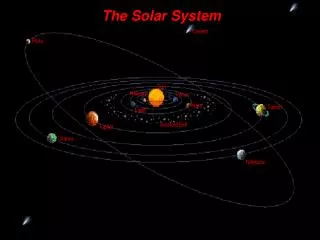
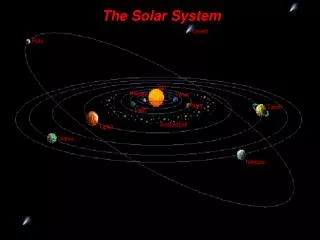
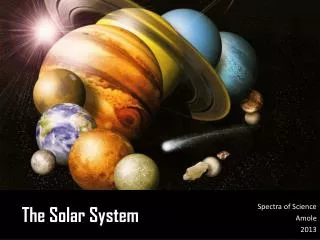
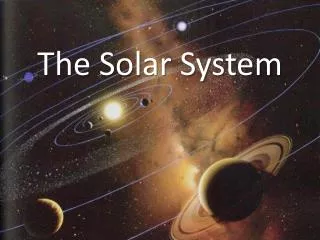
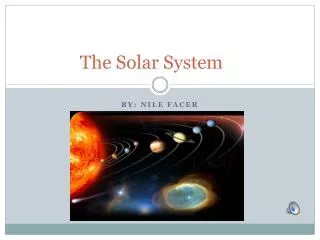
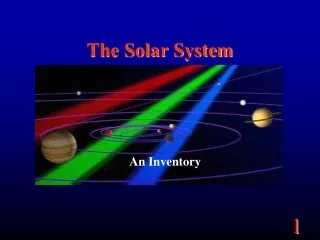
The Solar System comprises a diverse array of celestial bodies, with the Sun at its center, a typical medium-sized star producing energy through nuclear fusion. It includes ten planets, their moons, asteroids, comets, and interplanetary dust and gas. The inner planets—Mercury, Venus, Earth, and Mars—are rocky, while the outer planets—Jupiter, Saturn, Uranus, Neptune, and the dwarf planet Pluto—primarily consist of gases and ice. Discoveries of planets have been made over centuries, with Quaoar identified in 2002, adding to our understanding of our cosmic neighborhood.

The Solar System
E N D
Presentation Transcript
The Solar System The Sun and the Celestial Bodies
Sun • Typical medium-sized star • Radiation produced by nuclear fusion
Solar System • Ten planets and their satellites • Asteroids • Comets • Meteoroids • Interplanetary dust & gas
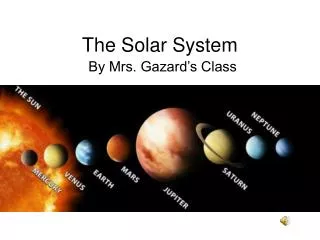
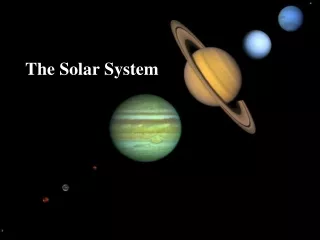
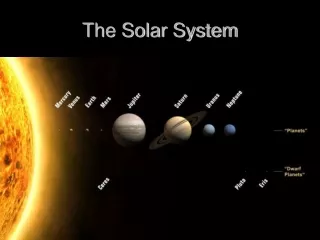
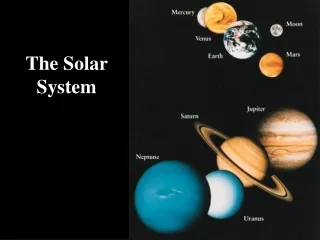
Major Planets • Inner planets • Mercury, Venus, Earth and Mars • Outer Planets • Jupiter, Saturn, Uranus, Neptune, Pluto, and Quaoar
Major Planets • Inner planets • small, rock and iron • Outer Planets • mainly hydrogen, helium and ice (Pluto*)
Movement of Planets • Elliptical orbits around the sun • Counterclockwise direction around the sun
Discoveries of the Planets • Mercury – Unknown • Venus – Unknown • Mars – Unknown • Jupiter – Unknown • Saturn – Unknown • Uranus – 1781 • Neptune – 1846 • Pluto – 1930 • Quaoar - 2002
Quaoar, The Newest Planet • Identified on June 4, 2002 • 800 miles in diameter • Almost perfectly circular 285-year orbit • About 6.3 billion km (4 billion miles) from the sun • Known by astronomers as 2002LM60
Origin • Debate continues!