Understanding Nucleic Acids: DNA and RNA Functions in Heredity and Protein Synthesis
Nucleic acids, including DNA and RNA, play crucial roles in heredity and protein synthesis, enabling living organisms to pass on traits. DNA, composed of genes, retains essential information for cellular activities and transmits favorable traits to future generations, driving evolution. In contrast, RNA facilitates protein production by transferring genetic instructions from DNA in the nucleus to ribosomes. Both nucleic acids consist of nucleotides, which include a pentose sugar, phosphate group, and nitrogenous bases, defining their unique roles in biological processes.

Understanding Nucleic Acids: DNA and RNA Functions in Heredity and Protein Synthesis
E N D
Presentation Transcript
Nucleic Acids Meghan Arora Jeff Chen Julia Kubik Pratibha Sharma Anna Ye
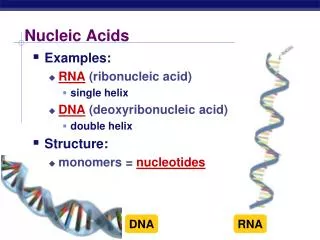
Types: • Deoxyribonucleic acid (DNA) • Ribonucleic acid (RNA) • These molecules: • Store and transmit • hereditary material • Allow living organisms to • pass on their traits Functions
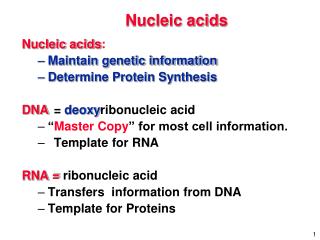
DNA • Made of hundreds to thousands of genes • Contains all the information that program all cell activities • During cell reproduction, DNA is copied and passed on to the next generation • Favourable traits are preserved, copied, and continue to be passed down • Species evolve
RNA • Synthesized by genes along the length of a DNA molecule • Controls protein synthesis • Sends genetic instructions for building proteins from the nucleus to ribosomes located in the cytoplasm
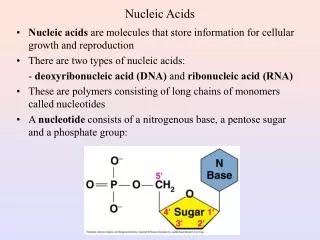
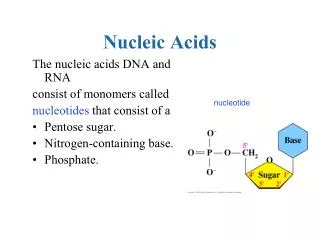
Monomer • Smallest unit of nucleic acids is a nucleotide • A nucleotide consists of: • pentose sugar • phosphate group • one of four different • nitrogenous bases • (A, G, C, and T or U) • RNA has ribose as its pentose and U as one of its bases • DNA has deoxyribose as its pentose and T as one of its bases
Parts of a Monomer: Nitrogenous Base There are two families of nitrogenous bases: pyrimidines and purines • Pyrimidines: • Six membered ring of carbon and nitrogen atoms • Purines • Six membered pyrimidine ring, fused to an additional five membered ring
Parts of a Monomer: Pentose • Ribose in nucleotides of RNA • Deoxyribose in DNA • Only difference is that deoxyribose lacks an oxygen atom on its number 2 carbon, hence the name
Parts of a Monomer: Phosphate Group • A phosphate group attached to the number 5 carbon of the sugar completes the construction of a nucleotide
Adenosine Triphosphate (ATP) The cell performs three main functions: 1. Mechanical Work 2.Transport Work 3. Chemical Work • Significance: • Main energy source in a cell- releases -7.3 kcal of energy per mole, ( -13 kcal/mol in natural environments) • Its high reactivity is caused by the triphosphate tail- the phosphate groups are all negatively charged and act like a loaded spring Pg.94
How ATP Performs Work • Energy released from the hydrolysis of ATP is used to transfer the extra phosphate group to energy absorbing reactions with the help of specific enzymes • The altered phosphorylated molecule is an intermediate and more reactive • Ex. synthesis of glutamine (an amino acid) from glutamic acid and ammonia • Another vital property of ATP is its regenerative quality, called the ATP cycle Pg.95
The ATP Cycle ATP can be recycled through the phosphorylation of ADP (when ADP combines with a phosphate), and where the energy required for that reaction comes from catabolism (breakdown reactions).In most cases, the energy comes from cellular respiration and light energy in plants. Below: The ATP cycle Pg.95
Works Cited http://rachelkahn3b.edublogs.org/2011/11/29/dna-structure-model-lab/ http://www.mrmacaraeg.com/Biology_11_Downloads.html http://en.wikipedia.org/wiki/File:RNA-comparedto-DNA_thymineAndUracilCorrected.png http://digitaljournal.com/img/8/7/3/i/5/9/6/o/060130dnastrand.jpg http://ap-bio-patrick-steed.wikispaces.com/DNA+vs+RNA,+DNA+Replication http://www.thaibiotech.info/Picture/Phosphate.gif