Understanding Electric Current: Key Concepts and Analogies
This guide explores essential concepts related to electric current, circuits, and resistance. Learn through engaging discussions and quick checks how electricity flows, the importance of conductors and insulators, and the role of voltage in creating an electric circuit. By using relatable analogies, such as comparing electric circuits to roller coasters and ski slopes, this activity aims to deepen comprehension and retention of complex ideas. Collaborate with a partner to solidify your understanding as you record insights on your worksheet.

Understanding Electric Current: Key Concepts and Analogies
E N D
Presentation Transcript
Warm-Up: With a partner, discuss the answers to this Anticipation Guide. Record your responses on your worksheet. The electricity that is in lightning is the same electricity that is used to power appliances in your home. You can get shocked if you touch a bare wire, but not if you touch a wire with rubber coating. Electric circuits are like roller coaster rides. A bird sitting on a wire can get electrocuted if it is not careful. There is no difference between a thick wire and a thin wire when it comes to the amount of energy flow.
Electric Current Page 692
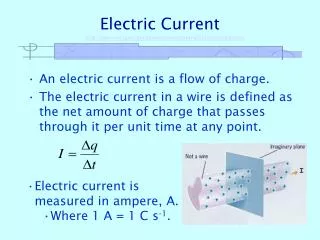
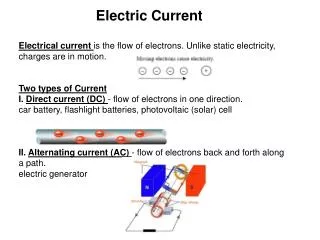
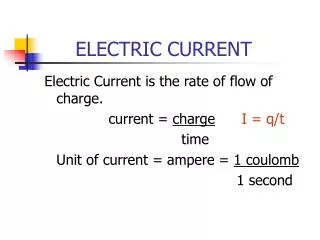
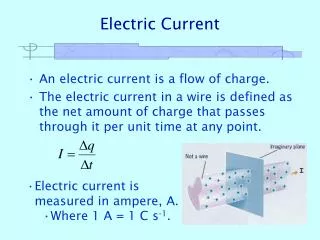
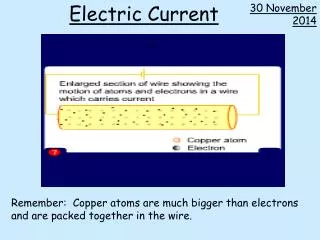
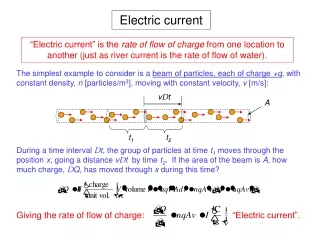
Electric Current • The continuous flow of electric charges through a material. • An amp (A) is the amount of charge that passes through a wire in a unit of time. Quick check: Which characteristic of electric current is represented in this ‘tomato conveyor belt’ photograph?
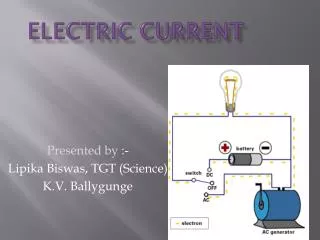
Electric Circuit • A complete, unbroken path through which electric charges can flow. Quick check: How is an electric circuit like a toy race track?
Conductor Insulator • A material through which charge can NOT flow easily. • A material through which charge can flow easily. Quick check: Explain why you don’t get a shock when you touch an extension cord?
Charges need ENERGY to flow • Charges in an electric circuit flow because of a difference in electrical potential energy. Quick check: How is a roller coaster like the flow of electricity?
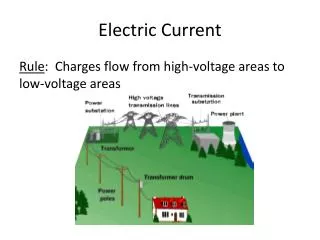
Voltage • The difference in electrical potential energy between two places in a circuit. • Unit of measure is the volt (V). • Causes a current in an electric circuit.
Voltage Source • A device that creates a potential difference in an electric circuit. • Ex: batteries and generators
Resistance • The measure of how difficult it is for charges to flow through a material • The greater the resistance, the less current there is for a given voltage • Unit of measure is the ohm ( ) Quick check: If you reduce the resistance in a circuit, will there be more or less or less current? Explain.
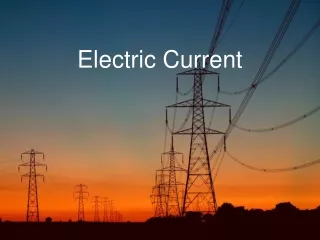
Path of Least Resistance • If electric charge can flow through either of two paths, more of the charge will flow through the path of least resistance. Quick check: Why don’t the birds get electrocuted?
Writing an Analogy: • An analogy can help people understand new information by comparing it to something familiar. Write a paragraph that compares an electric circuit to skiing down a slope and riding the chairlift to the top.