Colligative Properties
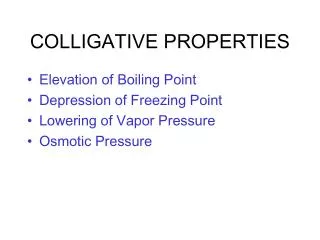
Colligative properties are crucial in determining how solute concentration affects the physical properties of solvents. They highlight that the identity of the solute is less relevant than the quantity present. Key examples include boiling point elevation and freezing point depression, such as using ethylene glycol to lower the boiling point of water or salt to melt ice. These properties are significantly impacted by electrolytes, which dissociate into ions, further altering the total concentration and behavior of solutions. Explore the calculations and real-life applications of these fascinating properties.


Colligative Properties
E N D
Presentation Transcript
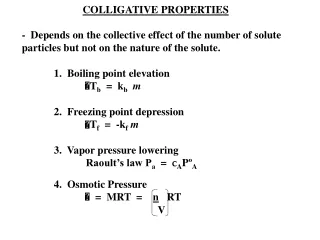
Colligative Properties • Properties where how much solute dissolved matters not what is being dissolved. • Ex: Osmosis
Colligative Properties • Boiling Point Elevation • Ex: coolant/ethylene glycol • Lowers the boiling point of water • Boiling point elevation • ∆T = kbm
Colligative Properties • Boiling point elevation • ∆T = kbm • What is the boiling point of 50. g of ethylene glycol in 50. g of water?
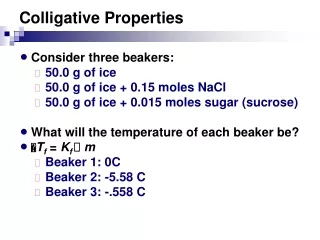
Colligative Properties • Freezing Point Depression • Ex: salt on ice • This melts ice by lowering the freezing point of the water • Ex: Antifreeze/ethylene glycol • Freezing point depression • ∆T = kfm
Colligative Properties • Freezing point depression • ∆T = kfm • What is the freezing point of 25 g of glucose, C6H12O6, in 75 g of ethanol?
Colligative Properties • This works well for nonelectrolytes • This a problem for electrolytes • Electrolytes (ionic compounds and acids) break into ions in water. • Remember the definition of a colligative property • It doesn’t matter what is dissolved just how much
Colligative Properties • NaCl Na+ + Cl- • 1 m of NaCl is really 1 m of Na+ and 1 m Cl- giving a total of 2 m • K3PO4 3K+ + PO4-3 • .25 m of K3PO4 is really .75 m of K+ and .25 PO4-3 giving a total of 1.0 m
Colligative Properties • For the following solutions what is the total concentration. • 0.15 m CuCl2 • 2.5 m CH3 • 0.50 m H2CO3 • 0.20 m Al2(SiO3)3
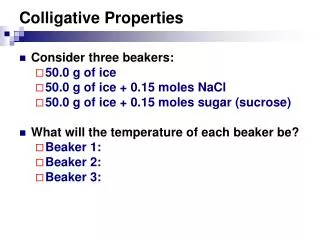
Colligative Properties • Which of the following would have the highest boiling point? • 0.25 m KCN • 1.0 m CH3OH • 0.50 m Ca(NO3)2 • 0.40 m HCl
Colligative Properties • What is the boiling point of 5.0 g of CuSO4 in 20. g of water?