Download
1 / 61
610 likes | 732 Views
Orthomyxoviruses, including Influenza A, B, and C, are spherical ssRNA viruses with a segmented genome responsible for respiratory infections. Key proteins such as PB2, PA, HA, and NA play crucial roles in viral replication and host interaction. The classification of Influenza A into HxNx subtypes is crucial for monitoring its evolution, including antigenic drift and shift. Paramyxoviruses, with their helical nucleocapsid and various surface glycoproteins, also primarily affect the respiratory tract. Understanding these viruses aids in diagnosing and managing infections and preventing outbreaks.

E N D
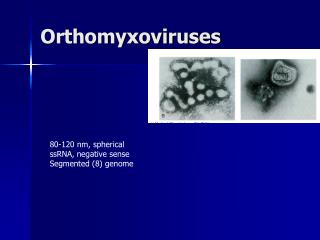
Orthomyxoviruses 80-120 nm, spherical ssRNA, negative sense Segmented (8) genome
Gen products: • PB2: RNA polymerase; recognise the cap • PB1-F2: Propaoptotic activity • PB1: RNA pol., endonuclease, elongation • PA: RNA pol.; protease • HA: Surface GP, receptor binding, fusion; major antigen • NP: RNA binding, RNA synthesis, transport of RNA to nucleus • NA: Surface GP; neuraminidase activity • M1: MAtrix protein; export from nucleus; interaction with vRNP surface glycoproteins; budding • M2: Membrane protein; ion channel activity; assembly • NS1: Multifunctional protein; agonist of viral IFN • NEP/NS2: Transport of vRNP from nucleus
M1, M2 and NP are typespecific İnfluenza A, B, and C
Strains of influenza A virus are classified by the following four characteristics: • Type (A, B, and C) • Place of original isolation • Date of original isolation • Antigen (HA and NA) Influenza A/New York/07/09 (H1N1)
Mutations in HA and NA genes Antigenic drift • Reassorments Antigenic shift
Incidence of clinically manifest influenza Mean level of population antibody vs A HxNx Mean level of population antibody vs A HyNy Pandemic Pandemic Interpandemic Period Epidemic Epidemic Disease Incidence Mean Population Antibody Level Epidemic 1 2 3 4 5 6 7 8 9 10 11 12 Time in Years Introduction of hypothetical A HxNx virus Significant minor variation A HxNx may occur at any of these points. Epidemics may or may not be associated with such variations Introduction of hypothetical A HyNy major (new subtype) variant A HxNx disappears Mandell, Douglas and Bennett’s Principles and Practice of Infectious Diseases, 5th ed. 2000:1829. Modified from Kilbourne ED. Influenza. 1987:274, with permission.
Epithelial demage () Viral shedding 5 -10 days No viremia Onset of the symptoms (1-5 days) Acute influenzaSymptoms regress (~ 5 day) Sekonder Bakteriyel Pnömoni/Komplikasyonlar Viral Pneumonia
Common Diagnostic tests Rapid Antigen (EIA) Sensitivity: 60-80% Specificity: 90% Culture (Shell Vial) Sensitivity: 70-80% Specificity: 100% RT-PCR, multiplex RT, multiplex PCR, array, luminex based DFA
15 kb lineer, negative sense RNA Speherical to plemorphic r > 150 nm 6 structutal proteins
Unique Features of the Paramyxoviridae • Large virion consists of a negative RNA genome in a helical nucleocapsid surrounded by an envelope containing a viral attachment protein (hemagglutinin-neuraminidase [HN], parainfluenza virus and mumps virus; hemagglutinin [H], measles virus; and glycoprotein [G], respiratory syncytial virus [RSV]) and a fusion glycoprotein (F). • The three genera can be distinguished by the activities of the viral attachment protein: HN of parainfluenza virus and mumps virus has hemagglutinin and neuraminidase, and H of measles virus has hemagglutinin activity, but G of RSV lacks these activities.
Virus replicates in the cytoplasm. • Virions penetrate the cell by fusion with the plasma membrane and exit by budding from the plasma membrane. • Viruses induce cell-cell fusion, causing multinucleated giant cells. • Paramyxoviridae are transmitted in respiratory droplets and initiate infection in the respiratory tract. • Cell-mediated immunity causes many of the symptoms but is essential for control of the infection.
♦ PIV types 1 and 2 most often cause outbreaks of croup in autumn/early winter, with an alternate year pattern. PIV-1 tends to attack children ages 2-6 years. • ♦ PIV-3 causes croup less commonly than PIV-1 and 2. Infections are sporadic and year-round, including spring and summer. Primary infection with PIV 3 in young infants and children <2 years of age is a fairly common cause of bronchiolitis and pneumonia. • ♦ PIV-4 infections, even primary infections, are usually milder and are generally associated with mild URI symptoms. • ♦ Particularly severe and persistent infections are known to occur in immunocompromised children and adults; prolonged viral shedding is seen.
Respiratory syncytial virus • RSV A • RSV B • November-May epidemics