Comprehensive Guide to Mass Spectra Interpretation and Elemental Isotopic Abundance
This resource provides an in-depth look at mass spectrometry, particularly the interpretation of mass spectra. It covers key concepts such as isotopic abundances for essential elements, magnetic filtration, and ion path characteristics. The text includes examples demonstrating how to calculate unsaturation and interpret halogen patterns. This guide serves not only as a reference but also as an educational tool, enhancing understanding of ion masses, charge interactions, and the factors influencing mass spectrometric analysis. Ideal for students and professionals in chemistry.

Comprehensive Guide to Mass Spectra Interpretation and Elemental Isotopic Abundance
E N D
Presentation Transcript
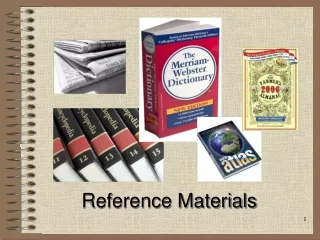
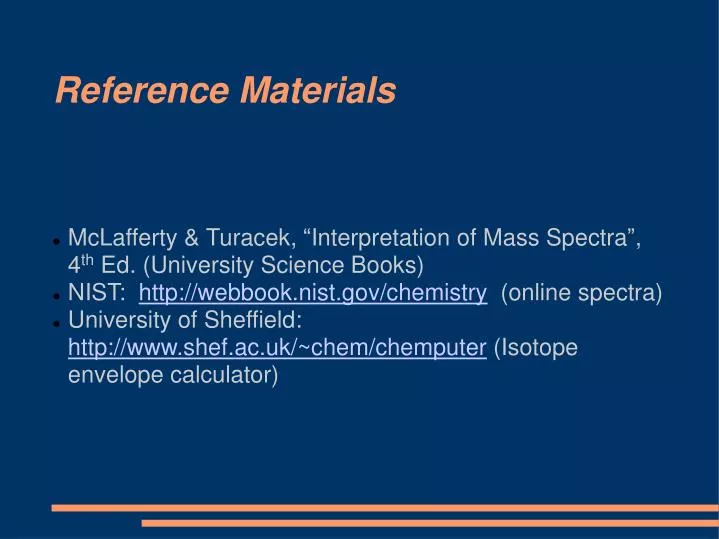
McLafferty & Turacek, “Interpretation of Mass Spectra”, 4th Ed. (University Science Books) NIST: http://webbook.nist.gov/chemistry (online spectra) University of Sheffield: http://www.shef.ac.uk/~chem/chemputer (Isotope envelope calculator) Reference Materials
Magnetic Mass Filtration m/z = 4.82 x 10⁻⁵ B2r2/V m Ion mass z Ion charge B Magnetic field strength (Gauss) r Radius of ion path (cm) V Ion accelerating voltage (volts)
Isotopic Abundances for Important Elements C: 12C 100 13C 1.1 14C <0.1 N: 14N 100 15N 0.37 H: 1H 100 2H 0.015 3H <0.001 Cl 35Cl 100 37Cl 32.5 Br: 79Br 100 81Br 98 O: 16O 100 17O 0.04 18O 0.20 Si: 28Si 100 29Si 5.1 30Si 3.4 S: 32S 100 33S 0.8 34S 4.4
Classification of elements A A+1 A+2 H C O F (19F) N Si P (31P) S I (127I) Cl Br
Example 1 12,42 13,17 14,17 15,1 26,168 27,999 28,17 29,1
Example 2 12,5 13,9 14,21 15,466 16,6 46,14 47,25 48,11 79,63 80,16 81,63 82,16 91,68 92,40 93,209 94,999 95,149 96,942 97,11
Calculating unsaturations (R + D) = x – ½ y + ½ z + 1 for CxHyNzOn Cl, Br, F =H S = O P = N Si = C