Wind and the Coriolis Effect
260 likes | 1.2k Views
Wind and the Coriolis Effect. Air pressure differences cause the movement of air Air moving parallel to the ground is called wind Air moving up or down is called a current. Air generally moves from the poles to the equator, this is because air flows from high pressure to low pressure


Wind and the Coriolis Effect
E N D
Presentation Transcript
Air pressure differences cause the movement of air • Air moving parallel to the ground is called wind • Air moving up or down is called a current
Air generally moves from the poles to the equator, this is because air flows from high pressure to low pressure • High pressure forms when cold air sinks (at the poles) • Low pressure forms when warm air rises (at the equator) • But the air doesn’t flow in a straight line
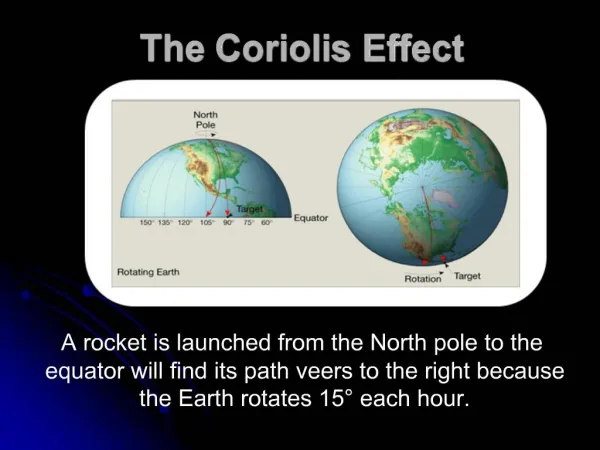
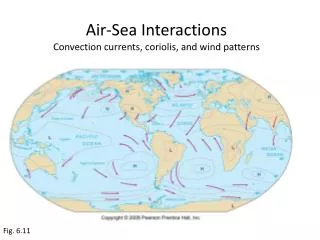
Coriolis Effect • Causes air to move in a curved path • It is caused by the Earth spinning on its axis • The Earth spins fastest at the equator, and slowest near the poles • As air moves from the equator to the pole, it will travel east faster than the land beneath it causing the air to follow a curved path
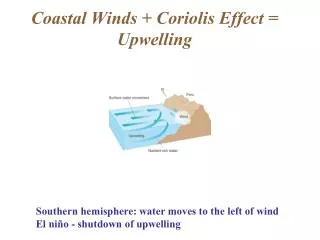
So the coriolis effect causes wind flowing from high pressure to low pressure to curve as the wind moves • In the Northern Hemisphere, the coriolis effect causes things to curve to the Right • In the Southern Hemisphere, the coriolis effect causes things to curve to the Left
Wind • Winds are created because of the uneven heating the Earth • As discussed before, air moves from high pressure to low pressure • Areas that are warmer are low pressure areas, so wind blows toward low pressure • Areas that are colder are high pressure areas, so wind blows away from high pressure • There are two types of winds • Planetary (or global) • local
Planetary wind • These winds blow across the entire planet • They generally blow at the same speed and direction • Some are high in the atmosphere and you cannot feel them on the ground • Each hemisphere contains 3 wind belts that divide up the planetary winds • Trade winds, Westerlies, and Easterlies
Trade winds • Blow toward the equator, an area of low pressure called Doldrums • Located between 0-30º north and south • Called trade winds because many European sailors used these winds for trade
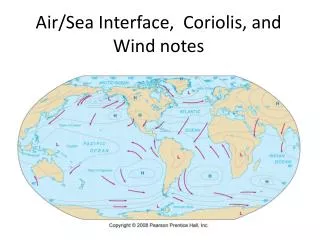
Trade winds cont. • In northern hemisphere, trade winds come from the NE, so they are called Northeast trade winds • In the southern hemisphere, trade winds come from the SE, so they are called Southeast trade winds *Notice the Coriolis Effect at work*
Westerlies • Between 30º and 60º latitude • High pressure at 30º causes air to descend and blow toward the poles • This zone of high pressure at 30º are called Horse Latitude
Westerlies cont. • In northern hemisphere, westerlies are southwest winds • In the southern hemisphere, westerlies are northwest winds
Polar Easterlies • Located above 60º latitude (between 60-90º) • High pressure over the poles (caused by the sinking cold dense air) causes the air to blow away from the poles toward 60º latitude
Polar Easterlies cont. • At north pole, they are northeast winds since the wind comes from the northeast • At the south pole, they are southeast winds since the wind comes from the southeast
Planetary Wind Shift • Because the Earth goes through seasons throughout the year, the wind belts can shift slightly • But the average shift is only about 10º
Local Winds • These winds blow over small areas • Unlike planetary winds, local winds can change speed and direct frequently • These are the winds we feel on the ground • They are influenced by local conditions and local temperature variations
Local Wind cont. • Land and sea breezes • During the day, the land heats up faster than the water, so a breeze will blow from the sea to the land, called a sea breeze
Local winds cont. • At night, the land will cool off faster than the water, so the cool land air will flow toward the warmer ocean water air, creating a land breeze, where the wind blows from the land to the sea
Local Winds cont. • Mountain and Valley Breezes • During the day, the valley heats up, so the warm less dense air flows up the mountain, creating a valley breeze
Local winds cont. • At night, the mountain will cool off faster than the valley, so the cool mountain air descends because it is more dense, creating a mountain breeze