Advancing Network Management: PANE, HFT, and Virtual Network Slicing Techniques
This lecture by Aditya Akella delves into innovative approaches for enhancing virtual networks through advanced functions like Participatory Networking (PANE) and High-Frequency Trading (HFT). It explores user interfaces for network control, privilege delegation, and conflict resolution, emphasizing the importance of isolation in network slices. Akella discusses the advantages and limitations of existing solutions, such as VLANs and Flowvisor, while providing insights into the integration of traffic management strategies and efficient policy enforcement in complex network environments.

Advancing Network Management: PANE, HFT, and Virtual Network Slicing Techniques
E N D
Presentation Transcript
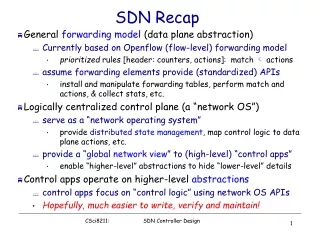
SDN Abstractions Lecture 20 Aditya Akella
Going beyond defining a virtual network, configuring specific network functions • Application interface • PANE: Participatory networking • Management • HFT: Delegation and conflict resolution • Splendid isolation: Slicing/isolation
Participatory networking and HFT • PANE: user interface for the network control plane • End-users, devices or applications • Key components: • Privilege delegation to reconcile requests and network constraints • A protocol and API to interaction • A suitable control logic
Privilege delegation • Hierarchy of shares • All shares can sub-delegate • Subsets defined on subsetof parent’s flow group • May not have more permissiveprivileges Which speakers canissue which messageson which flowgroups
“API” • Requests allow/deny, reserve, limit • Could be associated with time • “Come back later” • Hints for traffic prioritization, future traffic patterns • Queries read network state • Accept a message if • it passes privilege check, • referenced flowgroup is subset of share’s group, • if the request can co-exist with previously accepted requests
HFT • Hierarchy of privileges hierarchy of policies
HFT • Conflict resolution operators: node-internal, inter-sibling and parent-child
HFT • Conflict resolution operators: node-internal, inter-sibling and parent-child
HFT Operators Only Requirements: Associative, 0-identity • D and S identical. • Deny overrides Allow. • GMB combines as max • Child overrides Parent for Access Control GMB combines as max
Traffic isolation • Physical isolation • Control isolation
Some possibilities • VLANs obviously bad (why?) • Flowvisor • “Splendid”
Flowvisor Intercepts/analyzes/multiplexes events
Slices in Splendid • Make isolation part of the language. – For security and modularity. • Give each client a slice of the network which they can assume complete control over, as if they were alone on the network. • Given a set of slices and a policy for each slice, compile them into one wholenetwork program that enforces isolation.
Slices Outgoing pkts
Implementation Input: a set of slices and policies. (Must be VLAN-‐independent.) Output: a single, global policythat enforces isolation.
Issues with Splendid • Read-only slices. • Consider an admin/billing slice that monitors use. Isolation is too strong • Isolation as the way to “enforce” program modularity?
Flowvisor vs. Splendid Why is FV better? • Why is Splendid better?