Download
1 / 4
40 likes | 144 Views
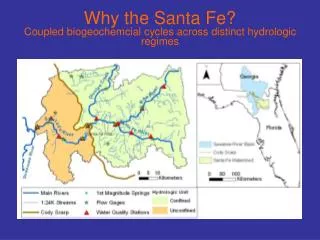
The Santa Fe Basin presents unique biogeochemical cycles influenced by varying hydrologic regimes. Current models inadequately address the complex NO3 vs. flow dynamics. This project seeks to compile existing monitoring data into a web-accessible geodatabase for researchers, enhancing our understanding of nitrate behavior across the basin. Tasks include data mining for prediction accuracy, deploying continuous sensors, and using findings to test new hypotheses. Conductivity will be explored as a proxy for nitrate export, revealing critical insights into the basin's hydrology.

E N D
Why the Santa Fe?Coupled biogeochemcial cycles across distinct hydrologic regimes
Current conceptual model inadequate Observed NO3 vs Flow Relationship Modeled NO3 vs Flow Relationship
Proposal Tasks • Compile existing monitoring data from state and federal mission agencies into a web-accessible geodatabase for use by local and non-local researchers • Mine existing agency data to predict stage and flux of water, conductivity and nitrate throughout stream network of the Santa Fe Basin, and quantify accuracy of the prediction. Design augmented network to improve prediction accuracy. • Deploy continuous NO3and CTD sensors at select locations. Link data to campus based computers through cell phone technology, serve in real-time on web, add QC’d data to geodatabase • Use new data to test predictions, test hypotheses and develop improved conceptual models
Potential hypotheses to be testedConductivity Proxy for NO3 Conductivity will provide a useful proxy for nitrate export in the unconfined region of the basin but not in the upper confined basin due to differences in hydrologic sources and flowpaths.