Understanding Intimate Partner Violence (IPV) and Its Impact on Health and Communities
This comprehensive curriculum explores the multifaceted issues surrounding Intimate Partner Violence (IPV), including its implications on women's health, child and adolescent development, and associated medical costs. It discusses the intersections of IPV with sexual health, behavioral health, and maternal and child health. Key strategies for public health responses, data sources for community assessments, and promising practices are highlighted. This resource aims to equip public health professionals with the knowledge to recognize, prevent, and effectively respond to IPV in various contexts.

Understanding Intimate Partner Violence (IPV) and Its Impact on Health and Communities
E N D
Presentation Transcript
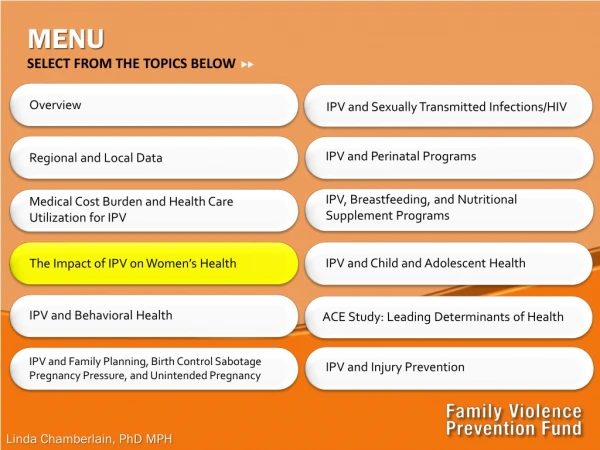
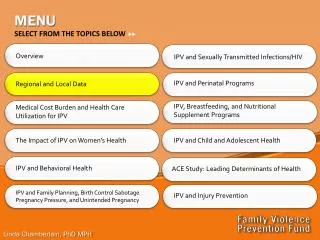
MENU SELECT FROM THE TOPICS BELOW Overview IPV and Sexually Transmitted Infections/HIV IPV and Perinatal Programs Regional and Local Data IPV, Breastfeeding, and Nutritional Supplement Programs Medical Cost Burden and Health Care Utilization for IPV IPV and Child and Adolescent Health The Impact of IPV on Women’s Health IPV and Behavioral Health ACE Study: Leading Determinants of Health IPV and Family Planning, Birth Control Sabotage Pregnancy Pressure, and Unintended Pregnancy IPV and Injury Prevention
POTENTIAL DATA SOURCES • PRAMS • BRFSS • YRBSS • NVDRS • Client surveys & needs assessments • Child protective services • Chart audits • Fatality review teams
POTENTIAL DATA SOURCES • Police data • Trauma registries • Domestic violence programs • 911 Dispatch logs • Hotline statistics • Restraining orders
PROMISING PRACTICE: MASSACHUSETTS • Surveillance methods linked multiple data sources • Homicide was the leading cause of maternal injury-related deaths • Majority (89%) of homicide deaths occurred in the late post-partum period • Two-thirds of homicide deaths were known or alleged cases of IPV MA Maternal Mortality and Morbidity Review, 2002
TOPICS COVERED IN THIS CURRICULUM • Overview • Regional and Local Data • Medical Cost Burden and Health Care Utilization for IPV • Impact of IPV on Women’s Health • IPV and Behavioral Health • IPV and Family Planning, Birth Control Sabotage, Pregnancy Pressure , & Unintended Pregnancy • IPV and Sexually Transmitted Infections & HIV • IPV and Perinatal Programs • IPV and Breastfeeding and Nutritional Supplements • IPV and Child and Adolescent Health • IPV and Adverse Childhood Experiences • IPV and Violence and Injury Prevention
TOPIC OUTLINE Each topic is organized as follows: • Learning Objectives • Overview and Statistics • Implications • Strategies • Promising Practices • Defining Success • *Additional information for each slide is provided in the “notes” viewing option
PUBLIC HEALTH RESPONSE TO IPV R Recognize the problem Educate the public Screen routinely Primary prevention focus Ongoing staff education New data sources Strategies for intervention Engage with community partners E S P R E S P O N S E O N S E