Redox Geochemistry
410 likes | 606 Views
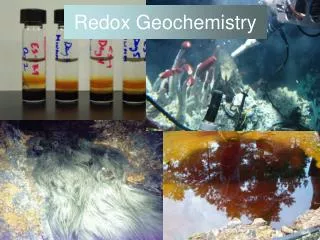
Redox Geochemistry. WHY?. Redox gradients drive life processes! The transfer of electrons between oxidants and reactants is harnessed as the battery, the source of metabolic energy for organisms


Redox Geochemistry
E N D
Presentation Transcript
WHY? • Redox gradients drive life processes! • The transfer of electrons between oxidants and reactants is harnessed as the battery, the source of metabolic energy for organisms • Metal mobility redox state of metals and ligands that may complex them is the critical factor in the solubility of many metals • Contaminant transport • Ore deposit formation
REDOX CLASSIFICATION OF NATURAL WATERS Oxicwaters - waters that contain measurable dissolved oxygen. Suboxic waters - waters that lack measurable oxygen or sulfide, but do contain significant dissolved iron (> ~0.1 mg L-1). Reducing waters(anoxic) - waters that contain both dissolved iron and sulfide.
O2 Aerobes Oxic H2O Dinitrofiers NO3- N2 Maganese reducers Post - oxic MnO2 Mn2+ Iron reducers Fe(OH)3 Fe2+ SO42- Sulfate reducers Sulfidic H2S CO2 Methanogens CH4 Methanic H2O H2 The Redox ladder The redox-couples are shown on each stair-step, where the most energy is gained at the top step and the least at the bottom step. (Gibb’s free energy becomes more positive going down the steps)
Oxidation – Reduction Reactions • Oxidation - a process involving loss of electrons. • Reduction - a process involving gain of electrons. • Reductant - a species that loses electrons. • Oxidant - a species that gains electrons. • Free electrons do not exist in solution. Any electron lost from one species in solution must be immediately gained by another. Ox1 + Red2 Red1 + Ox2 LEO says GER
Half Reactions • Often split redox reactions in two: • oxidation half rxn • Fe2+ Fe3+ + e- • Reduction half rxn • O2 + 4 e- + 4H+ 2 H2O • SUM of the half reactions yields the total redox reaction 4 Fe2+ 4 Fe3+ + 4 e- O2 + 4 e- + 4 H+ 2 H2O 4 Fe2+ + O2 + 4 H+ 4 Fe3+ + 2 H2O
Redox Couples • For any half reaction, the oxidized/reduced pair is the redox couple: • Fe2+ Fe3+ + e- • Couple: Fe2+/Fe3+ • H2S + 4 H2O SO42- + 10 H+ + 8 e- • Couple: H2S/SO42-
ELECTRON ACTIVITY • Although no free electrons exist in solution, it is useful to define a quantity called the electron activity: • The pe indicates the tendency of a solution to donate or accept a proton. • If pe is low - the solution is reducing. • If pe is high - the solution is oxidizing.
THE pe OF A HALF REACTION - I Consider the half reaction MnO2(s) + 4H+ + 2e- Mn2+ + 2H2O(l) The equilibrium constant is Solving for the electron activity
THE pe OF A HALF REACTION - II Taking the logarithm of both sides of the above equation and multiplying by -1 we obtain: or
THE pe OF A HALF REACTION - III We can calculate K from: so
WE NEED A REFERENCE POINT! Values of pe are meaningless without a point of reference with which to compare. Such a point is provided by the following reaction: ½H2(g) H+ + e- By convention so K = 1.
THE STANDARD HYDROGEN ELECTRODE If a cell were set up in the laboratory based on the half reaction ½H2(g) H+ + e- and the conditions aH+ = 1 (pH = 0) and pH2 = 1, it would be called the standard hydrogen electrode (SHE). If conditions are constant in the SHE, no reaction occurs, but if we connect it to another cell containing a different solution, electrons may flow and a reaction may occur.
STANDARD HYDROGEN ELECTRODE ½H2(g) H+ + e-
ELECTROCHEMICAL CELL Fe3++ e- Fe2+ ½H2(g) H+ + e-
ELECTROCHEMICAL CELL We can calculate the pe of the cell on the right with respect to SHE using: If the activities of both iron species are equal, pe = 12.8. If a Fe2+/a Fe3+ = 0.05, then The electrochemical cell shown gives us a method of measuring the redox potential of an unknown solution vs. SHE.
DEFINITION OF Eh Eh - the potential of a solution relative to the SHE. Both pe and Eh measure essentially the same thing. They may be converted via the relationship: Where = 96.42 kJ volt-1 eq-1 (Faraday’s constant). At 25°C, this becomes or
Eh – Measurement and meaning • Eh is the driving force for a redox reaction • No exposed live wires in natural systems (usually…) where does Eh come from? • From Nernst redox couples exist at some Eh (Fe2+/Fe3+=1, Eh = +0.77V) • When two redox species (like Fe2+ and O2) come together, they should react towards equilibrium • Total Eh of a solution is measure of that equilibrium
CALIBRATION OF ELECTRODES • The indicator electrode is usually platinum. • In practice, the SHE is not a convenient field reference electrode. • More convenient reference electrodes include saturated calomel (SCE - mercury in mercurous chloride solution) or silver-silver chloride electrodes. • A standard solution is employed to calibrate the electrode. • Zobell’s solution - solution of potassium ferric-ferro cyanide of known Eh.
Figure 5-6 from Kehew (2001). Plot of Eh values computed from the Nernst equation vs. field-measured Eh values.
PROBLEMS WITH Eh MEASUREMENTS • Natural waters contain many redox couples NOT at equilibrium; it is not always clear to which couple (if any) the Eh electrode is responding. • Eh values calculated from redox couples often do not correlate with each other or directly measured Eh values. • Eh can change during sampling and measurement if caution is not exercised. • Electrode material (Pt usually used, others also used) • Many species are not electroactive (do NOT react electrode) • Many species of O, N, C, As, Se, and S are not electroactive at Pt • electrode can become poisoned by sulfide, etc.
Other methods of determining the redox state of natural systems • For some, we can directly measure the redox couple (such as Fe2+ and Fe3+) • Techniques to directly measure redox SPECIES: • Amperometry (ion specific electrodes) • Voltammetry • Chromatography • Spectrophotometry/ colorimetry • EPR, NMR • Synchrotron based XANES, EXAFS, etc.
Free Energy and Electropotential • Talked about electropotential (aka emf, Eh) driving force for e- transfer • How does this relate to driving force for any reaction defined by DGr ?? DGr = nDE or DG0r = nDE0 • Where n is the # of e-’s in the rxn, is Faraday’s constant (23.06 cal V-1), and E is electropotential (V) • pe for an electron transfer between a redox couple analagous to pK between conjugate acid-base pair
Nernst Equation Consider the half reaction: NO3- + 10H+ + 8e- NH4+ + 3H2O(l) We can calculate the Eh if the activities of H+, NO3-, and NH4+ are known. The general Nernst equation is The Nernst equation for this reaction at 25°C is
Let’s assume that the concentrations of NO3- and NH4+ have been measured to be 10-5 M and 310-7 M, respectively, and pH = 5. What are the Eh and pe of this water? First, we must make use of the relationship For the reaction of interest rG° = 3(-237.1) + (-79.4) - (-110.8) = -679.9 kJ mol-1
The Nernst equation now becomes substituting the known concentrations (neglecting activity coefficients) and
Biology’s view upside down? Reaction directions for 2 different redox couples brought together?? More negative potential reductant // More positive potential oxidant Example – O2/H2O vs. Fe3+/Fe2+ O2 oxidizes Fe2+ is spontaneous!
Stability Limits of Water • H2O 2 H+ + ½ O2(g) + 2e- Using the Nernst Equation: • Must assign 1 value to plot in x-y space (PO2) • Then define a line in pH – Eh space
UPPER STABILITY LIMIT OF WATER (Eh-pH) To determine the upper limit on an Eh-pH diagram, we start with the same reaction 1/2O2(g) + 2e- + 2H+ H2O but now we employ the Nernst eq.
As for the pe-pH diagram, we assume that pO2 = 1 atm. This results in This yields a line with slope of -0.0592.
LOWER STABILITY LIMIT OF WATER (Eh-pH) Starting with H+ + e- 1/2H2(g) we write the Nernst equation We set pH2 = 1 atm. Also, Gr° = 0, so E0 = 0. Thus, we have
O2/H2O C2HO
Making stability diagrams • For any reaction we wish to consider, we can write a mass action equation for that reaction • We make 2-axis diagrams to represent how several reactions change with respect to 2 variables (the axes) • Common examples: Eh-pH, PO2-pH, T-[x], [x]-[y], [x]/[y]-[z], etc
Construction of these diagrams • For selected reactions: Fe2+ + 2 H2O FeOOH + e- + 3 H+ How would we describe this reaction on a 2-D diagram? What would we need to define or assume?
How about: • Fe3+ + 2 H2O FeOOH(ferrihydrite) + 3 H+ Ksp=[H+]3/[Fe3+] log K=3 pH – log[Fe3+] How would one put this on an Eh-pH diagram, could it go into any other type of diagram (what other factors affect this equilibrium description???)
Redox titrations • Imagine an oxic water being reduced to become an anoxic water • We can change the Eh of a solution by adding reductant or oxidant just like we can change pH by adding an acid or base • Just as pK determined which conjugate acid-base pair would buffer pH, pe determines what redox pair will buffer Eh (and thus be reduced/oxidized themselves)
Redox titration II • Let’s modify a bjerrum plot to reflect pe changes