Download
1 / 22
220 likes | 345 Views
This research explores the implications of an inhomogeneous dusty medium on Lyman-alpha (Lyα) emission, particularly from damped Lyα systems. The study analyzes the radiative transfer in HI gas and the factors affecting Lyα escape, including dust density, outflow velocities, and cloud velocity dispersion. The authors incorporate semi-realistic modeling based on historical data and numerical approaches. Key parameters such as HI column density, dust extinction, and star formation rates are evaluated to improve understanding of Lyα emissions in astrophysical contexts.

E N D
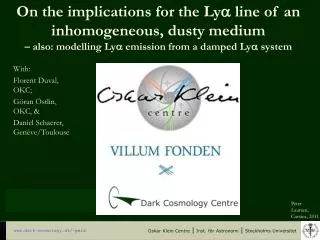
On the implications for the Lya line of an inhomogeneous, dusty medium – also: modelling Lya emission from a damped Lya system With: Florent Duval, OKC; Göran Östlin, OKC, & Daniel Schaerer, Genève/Toulouse Peter Laursen, Corsica, 2011 Oskar Klein Centre | Inst. för Astronomi | Stockholms Universitet www.dark-cosmology.dk/~pela
Gas density and temperature Dust density and cross-section Ly escape Analytical attempt (Neufeld 1990) T = 104, NHI = 1019, E(B–V) = 0.1
Ly escape – Why does Ly escape after all? Outflow? Kunth et al. (1999); Verhamme et al. (2006); Östlin et al. (2008)
Ly escape – Why does Ly escape after all? Ionized cones + viewing angle? Tenori-Tagle et al. (1999); Mas-Hesse et al. (2003)
Multiphase medium? Neufeld (1991); Hansen & Oh (2006) Ly escape – Why does Ly escape after all?
Equivalent width Definition: EW boost: EWobserved / EWintrinsic
Numerical approch MOCALATA
From ideal to semi-realistic • ICM density • Outflow velocity • Dust contents • Emission site • Cloud velocity dispersion
From ideal to semi-realistic • Density contrast threshold: nHI,ICM / nHI,cl ~ 10–4
From ideal to semi-realistic • Density contrast threshold: nHI,ICM / nHI,cl ~ 10–4 • Cloud velocity dispersion threshold: sV,cl ~ 50 km s–1
From ideal to semi-realistic • Density contrast threshold: nHI,ICM / nHI,cl ~ 10–4 • Cloud velocity dispersion threshold: sV,cl ~ 50 km s–1 • Expansion velocity threshold: Vexp ~ 50 km s–1
Modeling a damped Lyman a emitter With: P. Noterdaeme, P. Petitjean, M.-J. Maureira, S. D. Vergani, C. Ledoux, J. P. U. Fynbo, S. López and R. Srianand
Modeling a damped Lyman a emitter • NHI = 1022.1 cm–2
Modeling a damped Lyman a emitter • NHI = 1022.1 cm–2 • E(B–V) = 0.04
Modeling a damped Lyman a emitter • NHI = 1022.1 cm–2 • E(B–V) = 0.04 • Impact parameter ~ 1 kpc
Modeling a damped Lyman a emitter • NHI = 1022.1 cm–2 • E(B–V) = 0.04 • Impact parameter ~ 1 kpc • SFR ~ 20–25 M yr–1 • FLya = 14.3 × 10⁻¹⁷ erg s–1 cm–2 • fesc, Lya = 0.2
Modeling a damped Lyman a emitter • NHI = 1022.1 cm–2 • E(B–V) = 0.04 • Impact parameter ~ 1 kpc • SFR ~ 20–25 M yr–1 • FLya = 14.3 × 10⁻¹⁷ erg s–1 cm–2 • fesc, Lya = 0.2 • Red and blue part of the spectrum spatially detached
Semi-realistic modelling • NHI = 1022.1 cm–2 • E(B–V) = 0.04 • Impact parameter ~ 1 kpc • SFR ~ 20–25 M yr–1 • FLya = 14.3 × 10⁻¹⁷ erg s–1 cm–2 • fesc, Lya = 0.2 • Red and blue part of the spectrum spatially detached • Metallicity: [Zn/H] = -1.1 • Depletion patterns: [Zn/Fe] = 0.72, [Zn/Cr] = 0.49, [Zn/Mn] = 0.79, [Zn/Ni] = 0.61