
Impact of Housing Conditions and Sleep Deprivation on Rat Brain Injury Recovery
This study examines the effects of prior housing conditions and sleep loss on recovery from traumatic brain injury in rats. The performance on beam-walk motor tasks before and after the injury or sham surgery was evaluated, showing significant decreases in all groups on postoperative day 3 compared to baseline measures. By postoperative day 7, performance levels in the controlled cortical impact groups were comparable to baseline, but not in the no sleep deprivation + CCI group. By postoperative day 14, all groups performed at baseline levels. The findings suggest that sleep deprivation and housing conditions may influence recovery from brain injury in rats.

Impact of Housing Conditions and Sleep Deprivation on Rat Brain Injury Recovery
E N D
Presentation Transcript
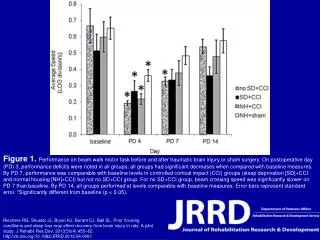
Figure 1. Performance on beam walk motor task before and after traumatic brain injury or sham surgery. On postoperative day (PD) 3, performance deficits were noted in all groups; all groups had significant decreases when compared with baseline measures. By PD 7, performance was comparable with baseline levels in controlled cortical impact (CCI) groups (sleep deprivation [SD]+CCI and normal housing [NH]+CCI) but not no SD+CCI group. For no SD+CCI group, beam crossing speed was significantly slower on PD 7 than baseline. By PD 14, all groups performed at levels comparable with baseline measures. Error bars represent standard error. *Significantly different from baseline (p < 0.05). Riechers RG, Shuster JL, Bryan KJ, Burant CJ, Ball SL. Prior housing conditions and sleep loss may affect recovery from brain injury in rats: A pilot study. J Rehabil Res Dev. 2013;50(4):455–62.http://dx.doi.org/10.1682/JRRD.2012.04.0061