Download
1 / 51
510 likes | 619 Views
This document delves into the social hierarchy of ancient Mesopotamia, detailing its three classes: Amelu, Mushkinu, and Wardu. It examines the roles of various societal members, including slaves at the bottom of the hierarchy and scribes responsible for record-keeping. The significance of Hammurabi's code of law, the first to apply universally, is highlighted, as well as the technological advancements like the arch and the wheel. This exploration provides a comprehensive view of how wealth, jobs, and governance shaped Mesopotamian civilization.

E N D
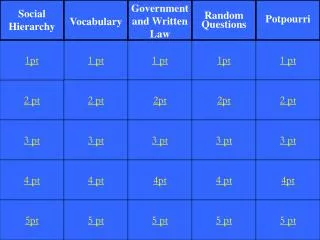
Government and Written Law Social Hierarchy Random Questions Potpourri Vocabulary 1pt 1 pt 1 pt 1pt 1 pt 2 pt 2 pt 2pt 2pt 2 pt 3 pt 3 pt 3 pt 3 pt 3 pt 4 pt 4 pt 4pt 4 pt 4pt 5pt 5 pt 5 pt 5 pt 5 pt
List the 3 Mesopotamian classes from top to bottom in order.
The bottom of social hierarchies was usually comprised of whom.
Trades people and businessmen comprised this Mesopotamian level.
Artificially bringing water to land for increasing plant growth.
A place with surrounding countryside that has the same leader of religious, political, economic, and cultural life.
A nickname for the punishments dictated by Hammurabi’s code.
What did surplus food allow the Mesopotamian civilization to have?
Name the most important building and its location in a Mesopotamian city-state
What was one of the King’s most important jobs in Mesopotamia?
There was none, just a dark underworld. Life was to please the gods
What was the problem that ancient Mesopotamians faced when they moved down to the rivers?