Download
1 / 20
200 likes | 351 Views
Understanding and Improving Spaceflight Teamwork in Long-Duration Missions Kim Jentsch , Ph.D. Eduardo Salas, Ph.D. Steve Fiore, Ph.D. University of Central Florida. Project Title. Technical Goals and Objectives. Technical Approach. Interviews with 12 NASA astronauts with LDSF experience

E N D
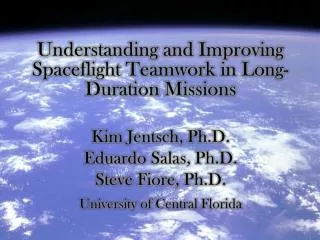
Understanding and Improving Spaceflight Teamwork in Long-Duration Missions Kim Jentsch, Ph.D. Eduardo Salas, Ph.D. Steve Fiore, Ph.D. University of Central Florida
Project Title Technical Goals and Objectives Technical Approach • Interviews with 12 NASA astronauts with LDSF experience • Observation of current team training • Analysis of archival data from analogue populations • Laboratory studies • Field experiment for new debriefing approach • Training for flight directors • Identify team training needs for LDSF crews • Develop and test team training strategies • Develop recommendations measuring teamwork and cohesion Strategic Alignment with NASA KSC Value and Benefit • Recommendations for team training content, methods, and sequencing prior to and during a mission • Identification of organizational support factors influencing training effectiveness • Validation of new team debriefing approach • Metrics for assessing teamwork and cohesion
Crew Resource Management Instructional Strategies Team Environments Aircrew Air Traffic Control Military Command and Control Nuclear power Shipping and maritime Medical Space flight • Awareness • Case studies / review of accidents and incidents • Demonstration • Practice • Role-plays • PC-based simulation • High fidelity simulation • Feedback • Post-performance debriefs (after action reviews)
Crew Resource Management Instructional Strategies Team Environments Aircrew Air Traffic Control Military Command and Control Nuclear power Shipping and maritime Medical Space flight • Awareness • Case studies / review of accidents and incidents • Demonstration • Practice • Role-plays • PC-based simulation • High fidelity simulation • Feedback • Post-performance debriefs (after action reviews)
Team Debriefs • Frustrating, inefficient, ineffective Motivating, focused, impactful
“Give a [team] a fish and they’ll eat for a day... … teach a [team] to fish and they’ll eat for a lifetime.”
1997-1998 Training Evaluation 2000-2002
Team Dimensional Training Team Effectiveness TDT teams showed 268% better performance than control group
Task Knowledge Team Dimensional Training Teamwork Knowledge Teammate Knowledge
Task Knowledge Team Dimensional Training Teamwork Knowledge Adaptive Performance Teammate Knowledge
TDT Process • Goals are process rather than outcome-oriented • Facilitator creates and maintains a psychologically safe learning climate • Discussion is structured around effective model of teamwork • Feedback is balanced in terms of positives and negatives • Team members self-correct
TDT Process • Goals are process rather than outcome-oriented • Facilitator creates and maintains a psychologically safe learning climate • Discussion is structured around effective model of teamwork • Feedback is balanced in terms of positives and negatives • Team members self-correct
TDT Process • Goals are process rather than outcome-oriented • Facilitator creates and maintains a psychologically safe learning climate • Discussion is structured around effective model of teamwork • Feedback is balanced in terms of positives and negatives • Team members self-correct
TDT Process • Goals are process rather than outcome-oriented • Facilitator creates and maintains a psychologically safe learning climate • Discussion is structured around effective model of teamwork • Feedback is balanced in terms of positives and negatives • Team members self-correct
TDT Process • Goals are process rather than outcome-oriented • Facilitator creates and maintains a psychologically safe learning climate • Discussion is structured around effective model of teamwork • Feedback is balanced in terms of positives and negatives • Team members self-correct
Field Experiment Can TDT improve individuals’ ability to perform in ad hoc teams? Can TDT reduce training time for certification?
Research Plan • Trainees in control condition (10 individual flight controllers) – no change to existing practices for debriefing • Trainees in treatment condition (10 individual flight controllers) - debriefed after integrated simulations using TDT • What is being collected? • 45 min survey of trainee personality and knowledge collected PRIOR to first integrated simulation • 5 min survey after 1st,- 4th integrated simulation (medium or high) • Card sorting task after 4th integrated simulation • Audio of debriefs for integrated simulations • Archival data on certification time
Preliminary Results • Significant improvement in perceptions of learning climate • Data on learning is trending in support of our expectations
Thank You! Questions?