Exploring Theories of Truth: Instrumentalism, Realism, and Hermeneutics
This text delves into various philosophical theories of truth, examining how different frameworks understand theoretical entities and their relation to reality. Instrumentalism views entities as tools for predictions rather than reflections of true realities, while realism asserts that theoretical claims must correspond with the real world. Additionally, it addresses conceptual relativism and its implications for observation and interpretation. The role of hermeneutics in interpreting texts is highlighted, emphasizing historical intentions and the evolution of meaning as seen in the works of thinkers like Schleiermacher, Wittgenstein, and Gadamer.

Exploring Theories of Truth: Instrumentalism, Realism, and Hermeneutics
E N D
Presentation Transcript
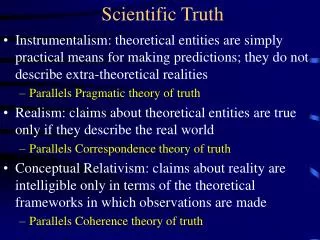
Scientific Truth • Instrumentalism: theoretical entities are simply practical means for making predictions; they do not describe extra-theoretical realities • Parallels Pragmatic theory of truth • Realism: claims about theoretical entities are true only if they describe the real world • Parallels Correspondence theory of truth • Conceptual Relativism: claims about reality are intelligible only in terms of the theoretical frameworks in which observations are made • Parallels Coherence theory of truth
Hermeneutics:The Study of Interpretation To determine truth in texts and actions, we have to interpret them (literally, symbolically) • Schleiermacher: a true interpretation reveals the historical author’s real intentions • Early Wittgenstein: propositions that really picture the structure of the world are true • Later Wittgenstein: meaning varies with use in life • Gadamer: our interpretations combine our “prejudices” and authorial intentions (1768-1834) (1889-1951)