Download
1 / 19
190 likes | 305 Views
This document explores significant advancements in the kinematics of weak decays, particularly focusing on observations from the KamLAND experiment and solar data. It discusses the implications of double beta decay and how improvements in source mass and detection methodologies can enhance data quality. The report references ASBL and LBL reactors, highlights challenges in background noise, and outlines future prospects with the KATRIN and MARE projects. These include efforts to achieve better energy resolution with cryogenic detectors and calorimeters that could significantly improve measurements of neutrino mass.

E N D
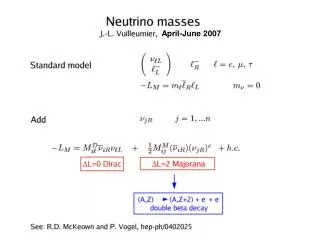
Oscillations: • Kinematics in weak decays: • 0n double beta decay: ?
solar Kamland Kamland + solar
Global fit to all existing data atmospheric, reactors (SBL) solar accelerators accelerators reactors (LBL)
To improve on T120n and <mn>: need large source mass lower background, better event signature
beta decay: For more information: Commins and Bucksbaum, Weak interaction of leptons and quarks
Integral electrostatic spectrometer
Mainz frozen T2 source, DE=4.8 eV Troitsk gaseous T2 source, DE=3.5 eV Reported anomaly most likely experimental artifact
Katrin (Karlsruhe) 23 m in final version
T2 injection (27 K) 10 m start data taking 2010
heat sink ( 8 mK) phonons i • Wide choice of materials • Good energy resolution crystal Stopping particle (ionizing or non ionizing) Cryogenic detectors (bolometers) Thermistor R(T) measure heat pulse
187Re 187Os + e- + ne E0=2.5 keV, 43 Gyr, abundance 62.8 % mn < 15 eV at 90 % CL (complication: ‘’ forbidden ’’ transition) Milano: 10 AgReO4 crystals (250-300 mg each) as cryogenic bolometers (T=10 mK) DE(FWHM)=28 eV at 2.5 keV
Next version: MARE (Microcalorimeter Array for a Rhenium Experiment) • 300calorimeters of a few 100 mg, with DE=10-20 eV • in progress, start data taking in 2010 for a few years • R&D for new thermistors • goal 5x10⁴ calorimeters with DE< 5 eV • Like KATRIN, but with completely different systematics!