Download
1 / 5
50 likes | 174 Views
This homework assignment explores the intricate relationship between media and government in the US as detailed in Chapter 10 of Wilson's work. It delves into the historical adversarial and symbiotic aspects of media interactions, emphasizing the balance between press freedom and profit motives. Key periods include the early partisan press, changes during the 1800s with the advent of mass communication and urbanization, and the rise of modern media, including radio, television, and the Internet. The assignment raises critical questions on media's impact on political news, campaigns, and governance.

E N D
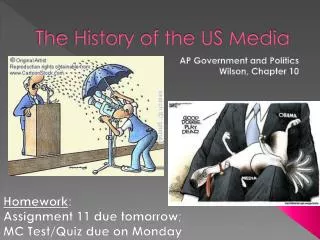
The History of the US Media AP Government and Politics Wilson, Chapter 10 Homework: Assignment 2 for tomorrow Quiz due Monday/MC Test Monday
Media and Government • Have very interesting relationship: • Adversarial • Symbiotic • Conflict with regard to reporting: • Freedom of the press and need to make a profit • With freedom comes responsibility • With freedom from government subsidy comes need to make a profit
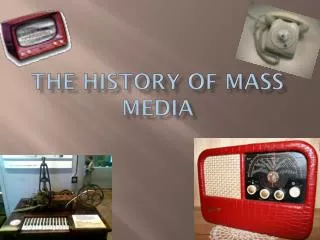
“Political Media” in the US • Early Republic - Papers of parties and factions • Low readership, expensive, some government assistance through patronage • Partisanship – related to government support • Changes in 1800s • Faster, cheaper press means mass readership; telegraph means up-to-date news • Urbanization enables more papers to be sold in smaller area • Partisanship – related to owners/editors • Late 1800s through the Progressive Era • National magazines appear; muckrakers • Circulation wars end; one newspaper towns become the norm • Less partisanship – sensationalism decreases as owners change and public becomes more educated • Mid 20th century • Radio and TV emerge; enable politicians to speak directly to audience, but could be turned off • TV/Radio more expensive and time is at a premium; Big 3 networks were only place to go for many years • Emergence of cable has given politicians a bit more airtime; offset decrease in length of soundbiteand attention span of viewers
The Internet and Politics • What has been the impact of the Internet on: • Political news? • Campaigns? • Governance? • Is the Internet a positive force for democracy?