Download
1 / 9
90 likes | 230 Views
This article delves into heap sort implementations and the complexities involved, specifically focusing on building heaps from arrays and analyzing average depths in trees. We explore two distinct approaches to create a heap: inserting elements one by one or utilizing the max-heapify method for efficient heap construction. The worst-case time complexity is analyzed, revealing a tighter upper bound of O(n log(n)). We also discuss the relationship between decision trees and sorting algorithms, emphasizing their significance in computational complexity.

E N D
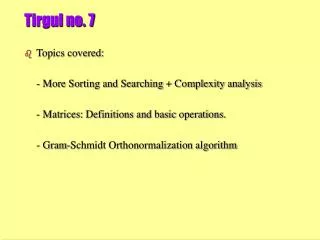
Tirgul 7 • Heap Sort • some more stuff DAST 2005
Build Heap • We have an array of numbers which we want to turn into a heap • Approach 1: • for i=1,...,n { • insert (A[i]) • } • (worst case) Complexity: • Approach 2: • for i=n/2 down to 1 { • max_heapify(A[i]) • } (due to convexity) (will happen for some input, for example a sorted array) DAST 2005
Build Heap • Complexity: • - We have a trivial upper bound of nlog(n) • - In fact, we can achieve a tighter bound: DAST 2005
Heap Sort • Complexity: • line 1 (build heap): O(n) • lines 2-5 nlog(n) • altogether O(nlog(n)) DAST 2005
Sorting - Summary DAST 2005
Ex4 – Q2.a We need to show that: DAST 2005
Ex4 – Q2.a We still have to decide whether the point is a local maxima, minima or an inflection point, but we know that: N/2 is a local minima →f(x) ≥ 0 DAST 2005
Ex4 – Q2.b • We have shown that the average depth of leaves in a tree containing n leaves islog(n) • When we fix the random decisions made by a random sorting algorithm we get a decision tree • The number of leaves in this tree is n!(although the algorithm is random, we still need to be able to reach all the possible permutations) • We need to show that there is at least one input, for which the average of all routes from root to leaf in all of the random decision trees is nlog(n) (remember, when we want to compute random complexity, we calculate an average of all the random decisions) DAST 2005
Ex4 – Q2.b • We can number the permutations from 1 to n! • A correct sorting of an input is a permutation in which for each i < j • We know that the average depth of the leaves in each of these trees is nlog(n) • There is at least one permutation, p, which matches a leaf that has an average depth of at least nlog(n) in all of the trees (remember that each leaf is a possible permutation of the input) • The random complexity of the algorithm (any algorithm) is Ω(nlog(n)) DAST 2005