
BMT Nigel Gee Ltd
E N D
Presentation Transcript
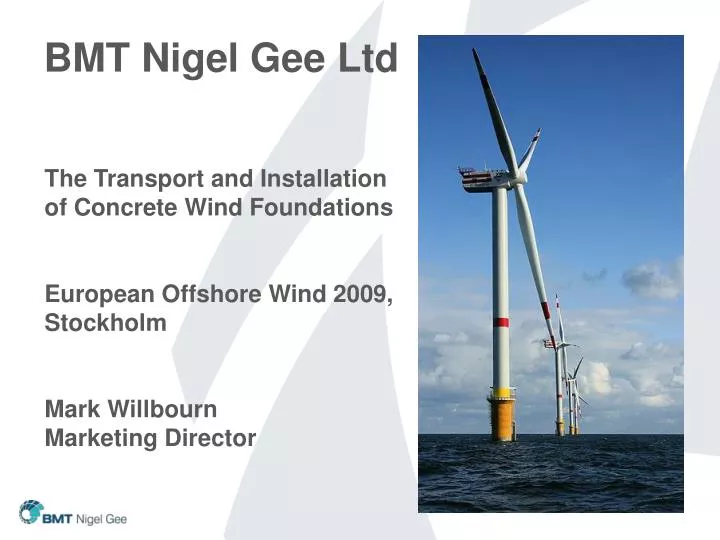
BMT Nigel Gee Ltd The Transport and Installation of Concrete Wind Foundations European Offshore Wind 2009, Stockholm Mark Willbourn Marketing Director
BMT Nigel Gee • Specialised in Naval Architecture and Marine Engineering Design Consultancy – part of BMT Group • Particular expertise in “specialised vessels” – high speed, low wash and vessels with excellent seakeeping characteristics • Experience in innovative new designs – 80m high speed catamaran for US Navy and patented 220m Pentamaran hull form • >150 vessels built to BMT NG designs – up to 220 LOA • BMT can provide not only design consultancy, structural and seakeeping analysis, etc. but also full construction detailed design packages for operators and shipbuilders and ship repair yards worldwide
Study Background • Gifford approached BMT NG to assist in Concrete Foundations study following earlier feasibility study on suitability for wind farm foundations. • BMT NG’s specific task was to provide innovative but workable solutions to task of moving large foundations to wind farm sites. • Study work included review of: • Structural requirements for “vessel” • Stability assessments • Latching mechanism • Towing requirements • Seakeeping assessments • Logistics analysis
Study Objectives • To provide an integrated systems approach to the tasks: • Coordinate design and construction of foundation and installation methodology for efficient production • Use conventional concrete construction technology onshore • Maximise operational weather window for offshore transit and installation • Minimise reliance on expensive offshore heavy lift equipment • Use relatively simple barge concept for transport and installation
Concrete Foundation Design • Pre-stressed concrete • Slipformed stem • Reduced stem diameter at sea bed level
Onshore Construction Site Offices / Workshops Building Pads Load Out Quay TIB
Launch of Foundation Vertical Launch Platform
TIB Connected Over Foundation TIB Vertical Launch Platform Base Unit
TIB Features, for 3600 Te Foundation LOA : 34 m Beam : 32 m Minimum Draft : 6.2 m Operating Draft : 9.0 m Required Water Depth with Foundation Unit : 11.3 m
TIB Features • Dumb barge, power only for ballast and latching systems • Unmanned barge for normal operations • Simple for remote operation • High lift and transport capacity • Relatively fast system
TIB Under Tow Maximum Hs = 3.0m
Seakeeping Analysis • Undertaken using VERES programme in-house by BMT • Operating criteria based on forces and motion limits that foundation could reasonably expect to withstand and safety margins • Motion criteria for placement of foundation on sea bed are significantly more restrictive then for transit : • Impact force on sea bed • Risk of foundation bouncing on sea bed • Risk of distortion of prepare bed • Transit criteria – no significant restrictions up to 3m significant wave height • Placement criteria – limited to 1.25m significant wave height, depending on water depth
TIB and Foundation Placed on Sea Bed • TIB ballast tanks flooded under control to place Base Unit onto sea bed • Maximum significant wave height Hs = 1.2m
TIB Disconnected • TIB disconnects from Base Unit • TIB deballasted with compressed air and towed off
Manoeuvring Simulations • Not yet completed but BMT has PC Rembrandt to undertake bespoke simulations to enable operations and tow masters to: • Establish safe operating limits • Investigate tow and handling strategies • Assess risks for tows • Assess marine issues for installation and de-comissioning • Assess mooring arrangements
Conclusion • Adaptation of existing technologies can provide low cost solution to transport and installation of concrete foundations • Seakeeping analysis has determined that transport is feasible in up to 3m significant wave height • Installation is possible in up to 1.25m significant wave height, depending on water depth • Use of TIB concept could enable installation operations in wider weather windows • As foundations get larger, operating window extends