Download
1 / 10
100 likes | 216 Views
This document provides a comprehensive overview of redox reactions, including key definitions such as reduction (gain of electrons), oxidation (loss of electrons), and disproportionation (same species oxidised and reduced). It details specific reactions, including the conversion of magnesium carbonate to magnesium sulfate and the reduction of copper oxide, with clear identification of oxidised and reduced species through oxidation state changes. The process of nitric acid manufacturing from ammonia is analyzed through its various reaction stages, emphasizing electron transfer and oxidation state modifications.

E N D
Redox Revision AS F321 Oct 2012
Definitions • Define the following terms: • Reduction • Oxidation • Disproportionation
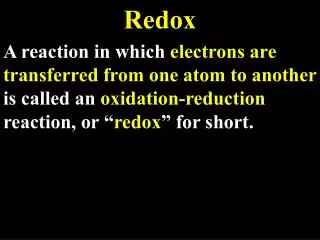
Definitions: Answers • Reduction: gain of electrons • Oxidation: loss of electrons • Disproportionation: the same species is both oxidised and reduced
Oxidation numbers • Work out the oxidation number of the species underlined/highlighted on your card
For each of the following reactions state whether it is a redox reaction or not. If it is a redox reaction state and explain what has been reduced and oxidised. • MgCO3 + H2SO4→ MgSO4 + H2O + CO2 • CuO + C → Cu + CO Extension equation: 3Mn3O4 + 8Al → 9Mn + 4Al2O3
Equation answers • MgCO3 + H2SO4→ MgSO4 + H2O + CO2No change in oxidation state – not a redox reaction (neutralisation) • CuO + C → Cu + CO Redox reaction: Copper reduced as oxidation state changed from +2 to 0. Carbon oxidised as oxidation state changed from 0 to +2. • 3Mn3O4 + 8Al → 9Mn + 4Al2O3Redox reaction: Manganese reduced as oxidation state changed from +2.67 to 0. Aluminium oxidised as oxidation state changed from 0 to +3.
Nitric acid is manufactured from ammonia in a process that involves several stages: a) 4NH3(g) + 5O2(g) ↔4NO(g) + 6H2O(g) b) 2NO(g) + O2(g) ↔ 2NO2(g) c) 2NO2(g) + H2O(l) →H+(aq) + NO3–(aq) + HNO2(aq) • For reaction (a) state and explain using oxidation numbers which species have been oxidised and which have been reduced. • For reaction (b) explain what has happened in the reaction in terms of electrons. • Give the oxidation states of nitrogen in each of the species in reaction (c). Explain what type of reaction this is.
Oxygen has been reduced – oxidation state changed from 0 to -2. Nitrogen has been oxidised – oxidation state changed from -3 to +2. • Nitrogen has been oxidised (+2 to +4). It has lost 2 electrons (oxidation is loss of electrons). Oxygen has been reduced (0 to -2). It has gained 2 electrons (reduction is the gain of electrons). • Nitrogen has the following oxidation states in reaction 3: • NO2 = +4 • NO3- = +5 • HNO2 = +3 • This is a disproprtionation reaction as nitrogen has been both oxidised (oxidation number changed from +4 to +5) and reduced (oxidation number changed from +4 to +3)