Comprehensive Workplace-Specific Language Training Program Guidelines
Our Workplace-Specific Language Training Program is designed to assess and enhance language skills tailored to industry needs. Through stakeholder input, present situation analysis, and targeted training development, we ensure participants master essential language capabilities for effective job performance. Instructors are carefully selected based on their experience and qualifications to support a meaningful learning experience. The program includes ongoing evaluation measures to assess progress, effectiveness, and long-term applicability in the workplace, fostering enhanced efficiency and communication.

Comprehensive Workplace-Specific Language Training Program Guidelines
E N D
Presentation Transcript
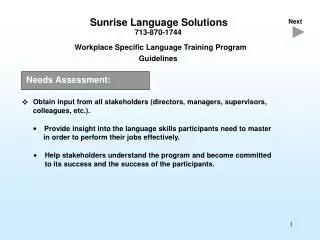
Next Sunrise Language Solutions 713-870-1744 Workplace Specific Language Training Program Guidelines Needs Assessment: Obtain input from all stakeholders (directors, managers, supervisors, v colleagues, etc.). · Provide insight into the language skills participants need to master in order to perform their jobs effectively. · Help stakeholders understand the program and become committed to its success and the success of the participants.
Prev Next Needs Assessment Cont’d: Determine Present Situation Analysis (PSA). v · Use observation, interviews, and surveys in order to identify and analyze needs. · Collect information from stakeholders. · Administer proficiency tests to assess present language skills. v Determine Target Situation Analysis (TSA). · Identify appropriate grouping for participants (where numbers permit, work tasks, language proficiency, etc.). · Set realistic expected outcomes.
Prev Next Program Development: Develop a relevant and authentic training program that is workplace v specific. Develop training materials that consist of existing client-specific v literature and augment with relevant provider-specific materials. Develop role-playing activities and group activities to engage participants v using work-related language use. Develop work-related authentic practice exercises to engage participants. v
Prev Next Effective Staff Support: Select qualified and experienced instructors. v · TEFL/ESL Certified (Teaching English as a Foreign/Second Language) Certified by an accredited college/university or state ü recognized organization Bilingual (English and Spanish) ü · Cognizant of the workplace culture · Knowledgeable about language teaching methodology for adult learners · Act as an effective liaison between training provider and client · External Professional Development Members of TESOL (Teachers of English to Speakers of Other Languages)
Prev Next Performance Objectives: Describe measurable outcomes and document progress by the training v provider and the client. SWSBAT - Student Will Successfully Be Able To…….. · Demonstrate task ü Examples: ¨ give instructions ¨ read and understand safety labels (OSHA-compliance) ¨ answer customers’ questions ¨ take a phone message
Prev Next Cost Analysis: Develop a budget that accommodates the client’s request to the extent v possible. · Assessment · Curriculum development · Instruction · Training materials · Indirect costs (overhead)
Program Evaluation: Prev Next What is being evaluated and why? v · What do participants know that they did not know before? · To what extent are they able to perform the objectives? · To what degree does the program show that it has met its goal? · What is the effectiveness of the training provider? Assess ability of participants to transfer their new knowledge to the v workplace. · Questionnaires to elicit participants’ feelings about the program content, instructional method, and the instructor · Questionnaires or interviews to elicit comments from stakeholders · Feedback from instructors on effectiveness of the instructional curriculum and the usefulness of specific materials and activities
Prev Return Program Evaluation Cont’d Provide a written report of evaluation results. v · Show the ways in which the goals have been met and the areas in which further training may be needed. Conduct Periodic Follow-up (If feasible). v Are participants continuing to apply the language in the ü workplace? In what way has the participants’ transfer of knowledge impacted ü the organization (efficiency, safety, customer relations, etc.)?