Night
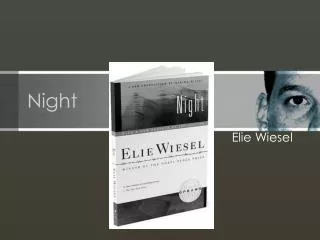
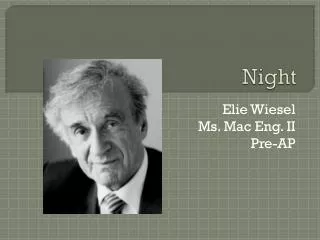
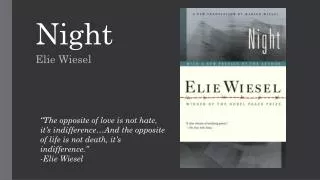
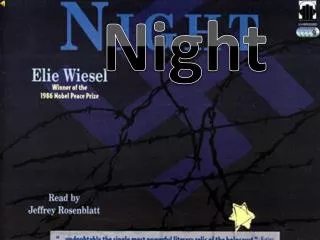
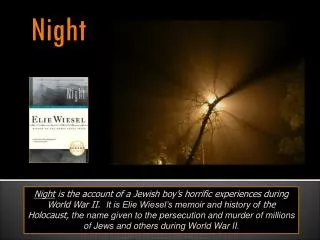
Elie Wiesel's "Night" is a powerful memoir that recounts his harrowing experiences during the Holocaust, a time marked by the systematic genocide of Jews and other marginalized groups. Through his poignant narrative, Wiesel addresses themes of faith, suffering, and resilience. This book serves as both a historical account and a moral lesson, reminding us of the consequences of hatred and indifference. Wiesel's work has become crucial in Holocaust education and has sparked conversations about human rights and compassion, urging all to remember the past to avoid repeating it.


Night
E N D
Presentation Transcript
By Elie Wiesel Night
genocide • noun • The systematic annihilation of a political, racial, or cultural group.
holocaust • Noun • Widespread or complete destruction
pious • Adjective • Earnestly religious or devout; or • Solemn hypocrisy
lamentation • Noun • The act of lamenting or mourning • An expression of regret or sorrow
synagogue • Noun • A Jewish church
waiflike • Adjective • Like a homeless or abandoned child
timidity • Noun • Shyness
cabbala Mystical Jewish teachings: a body of mystical Jewish teachings based on an interpretation of the Hebrew scriptures as containing hidden meanings
Gestapo • Noun • The secret police of Nazi Germany
lorries • Noun • A motor truck
Zionism • Noun • A movement or plan for establishing a Jewish homeland in Palestine • Zion is also known as the Jewish people or the city of God: heaven
fascist • Adjective • Marked by dictatorship and strict socioeconomic conditions
ghetto • Noun • A section of a town or city blocked off that imprisoned Jews during the Holocaust; it was surrounded by barbed wire and Nazi soldiers
deportation • Noun • Banishment from a country
phylacteries • Noun • Leather boxes that contain parchments of Jewish scriptures that are worn by men during morning worship
swine • Noun • A mammal that includes pigs and hogs; or • A despicable person
Concentration Camps • Auschwitz • Birkenau • Buna • Gleiwitz • Buchenwald