Download
1 / 6
60 likes | 177 Views
This guide provides a comprehensive overview of arithmetic sequences, including how to identify the next three terms and derive the nth term formula. We explore examples and exercises, helping you grasp concepts like the first term and common difference. By understanding the formula (u_n = u_1 + (n - 1)d), you’ll learn to calculate any term in an arithmetic sequence. Join us in solving sequences such as 2, 6, 10, and many others, enhancing your math skills and confidence in working with sequences.

E N D
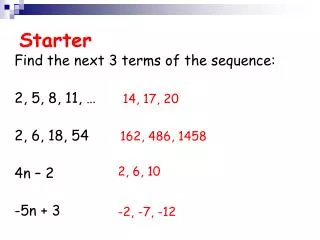
Starter Find the next 3 terms of the sequence: 2, 5, 8, 11, … 2, 6, 18, 54 4n – 2 -5n + 3 14, 17, 20 162, 486, 1458 2, 6, 10 -2, -7, -12
Note 3: Arithmetic Sequences The formula for an arithmetic sequence is: un = u1 + (n – 1)d u1 = first term d = common difference = un+1 - un un = the nth term • An arithmetic sequence is where a number is added to get the next term • The number is called the common difference
Example 1 u1 = d = 2 4 un = u1 + (n – 1)d u24 = 2 + (24 – 1)4 = 94 Calculate the 24th term in the arithmetic sequence 2, 6, 10, 14, …
Sometimes you may not be asked for a term, but other parts of the formula, requiring rearranging and solving: u1 = d = 2 2 un = u1 + (n – 1)d 644 = 2 + (n – 1)x2 644 = 2 + 2n - 2 644 = 2n n = 322 Example 2 In the sequence 2, 4, 6, 8,….what is term 644?
Example 3 u1 = d = 5 4 un = u1 + (n – 1)d un = 5 + (n – 1)4 = 5 + 4n - 4 = 4n + 1 Find the formula for the nth term of the sequence 5, 9, 13, 17, …
Page 436 Exercise 14C Q 1-6