Understanding Fin Effectiveness in Heat Transfer for Adiabatic Fins
This article explores the concept of fin effectiveness, a crucial factor in enhancing heat transfer in thermal systems, particularly for adiabatic fins. It discusses the relationship between thermal conductivity, convection coefficients, and fin design, emphasizing that fins are more effective in low convection environments. The article also presents formulas for calculating total heat loss, surface areas, and efficiencies of fin arrays. By understanding these principles, engineers can optimize fin designs to improve heat transfer rates in various applications.

Understanding Fin Effectiveness in Heat Transfer for Adiabatic Fins
E N D
Presentation Transcript
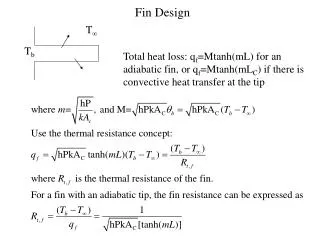
Fin Design T Tb Total heat loss: qf=Mtanh(mL) for an adiabatic fin, or qf=Mtanh(mLC) if there is convective heat transfer at the tip
Fin Effectiveness How effective a fin can enhance heat transfer is characterized by the fin effectiveness f: Ratio of fin heat transfer and the heat transfer without the fin. For an adiabatic fin:
Fin Effectiveness (cont.) • To increase f, the fin’s material should have higher thermal conductivity, k. • It seems to be counterintuitive that the lower convection coefficient, h, the higher f. But it is not because if h is very high, it is not necessary to enhance heat transfer by adding heat fins. Therefore, heat fins are more effective if h is low. Observation: If fins are to be used on surfaces separating gas and liquid. Fins are usually placed on the gas side. (Why?) • P/AC should be as high as possible. Use a square fin with a dimension of W by W as an example: P=4W, AC=W2, P/AC=(4/W). The smaller W, the higher the P/AC, and the higher f. • Conclusion: It is preferred to use thin and closely spaced (to increase the total number) fins.
Fin Efficiency For infinite k T(x)=Tb, the heattransfer is maximum T(x)<Tb for heat transfer to take place Tb x x Total fin heat transfer qf Ideal heat transfer qmax Real situation Ideal situation
Fin Efficiency (cont.) Use an adiabatic rectangular fin as an example: Figures 8-59, 8-60
Overall Fin Efficiency Overall fin efficiency for an array of fins: qf Define terms: Ab: base area exposed to coolant Af: surface area of a single fin At: total area including base area and total finned surface, At=Ab+NAf N: total number of fins qb
Heat Transfer from a Fin Array =Ab+NAb,f
Thermal Resistance Concept L1 A=Ab+NAb,f t Rb=t/(kbA) T1 T T1 Tb T2 T R1=L1/(k1A) Tb T2