Download
1 / 3
0 likes | 1 Views
In the textile and industrial winding industries, even the smallest components can plan an outsized role in determining the quality and efficiency of the operation and output. Among these small components, the metal bobbin stands out as a critical element in high-speed precision-driven environment. While bobbins may seem insignificant at first glance, their material and design significantly influence yarn handling, machine stability, and long-term operational reliability. The blog below explores metal bobbins and their importance in textile and industrial winding applications.

E N D
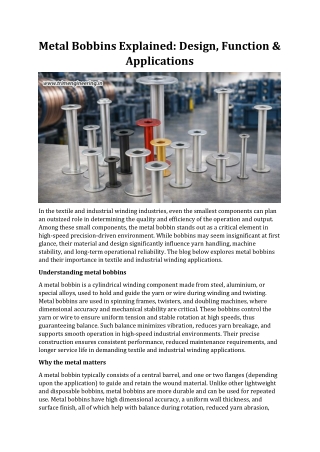
Metal Bobbins Explained: Design, Function & Applications In the textile and industrial winding industries, even the smallest components can plan an outsized role in determining the quality and efficiency of the operation and output. Among these small components, the metal bobbin stands out as a critical element in high-speed precision-driven environment. While bobbins may seem insignificant at first glance, their material and design significantly influence yarn handling, machine stability, and long-term operational reliability. The blog below explores metal bobbins and their importance in textile and industrial winding applications. Understanding metal bobbins A metal bobbin is a cylindrical winding component made from steel, aluminium, or special alloys, used to hold and guide the yarn or wire during winding and twisting. Metal bobbins are used in spinning frames, twisters, and doubling machines, where dimensional accuracy and mechanical stability are critical. These bobbins control the yarn or wire to ensure uniform tension and stable rotation at high speeds, thus guaranteeing balance. Such balance minimizes vibration, reduces yarn breakage, and supports smooth operation in high-speed industrial environments. Their precise construction ensures consistent performance, reduced maintenance requirements, and longer service life in demanding textile and industrial winding applications. Why the metal matters A metal bobbin typically consists of a central barrel, and one or two flanges (depending upon the application) to guide and retain the wound material. Unlike other lightweight and disposable bobbins, metal bobbins are more durable and can be used for repeated use. Metal bobbins have high dimensional accuracy, a uniform wall thickness, and surface finish, all of which help with balance during rotation, reduced yarn abrasion,
and resistance to deformation even under high tension or speed. The rigidity of these bobbins also ensures that the bobbin retains its shape throughout its service life, rather than warping, cracking, or losing dimensional stability due to heat or mechanical stress, like in the case of other types of bobbins. Precisely machined to achieve tight weight tolerances, minimizing vibration and reducing wear on the spindles and bearings, metal bobbins maintain consistent performance cycle after cycle. How metal bobbins differ from other bobbin materials Comparing metal bobbins in detail with other material types can give a better understanding as to why metal bobbins are preferred in most industrial settings. •Plastic and nylon bobbins are light in weight, making them suitable for low- speed or short-term applications. Their low mechanical strength limits their performance in high-tension or high-speed applications. These bobbins, over time, can wear and deform, thus causing imbalance and negatively affecting yarn quality and machine efficiency. •Phenolic bobbins offer improved heat resistance as compared to plastic and nylon bobbins, but they still lack the long-term structural stability and precision balance that metal bobbins can provide. Phenolic bobbins are suitable for only moderate-duty applications. •Metal bobbins excel in strength, durability, and dimensional accuracy, making precision and long-tern use non-negotiable. The heavy weight helps with stable rotation and balance, even in high-speed or high-tension applications. Metal bobbins can also handle higher loads and temperatures without flexing or warping, making then suitable for heavy-duty and continuous industrial use. As you can see, metal bobbins are far more strong, durable, and accurate as compared to other materials, and can also withstand heavy loads, high temperatures, and high speeds. This is what makes them most preferred in most industrial applications. Types of metal bobbins used in textile machinery While all metal bobbins share the same basic advantages, there are a variety of different types of metal bobbins that can be chosen as per the specific application and machine requirement. •Flange bobbins: Flange metal bobbins are the most common types used, especially in spinning and rewinding applications. The flange helps guide the yarn evenly across the barrel, and prevents slippage during winding. •Double-flange bobbins: Double-flange metal bobbins confine the yarn between two flanges, ensuring consistent winding geometry and additional control than the basic flange bobbins. Their design also reduces the risk of tangling or edge buildup, which is especially useful in high-speed or high-tension environments. •Perforated bobbins: Perforated metal bobbins have holes or slots along the barrel, which improve airflow and heat dissipation, and also reduces the overall
weight of the bobbin, while maintaining structural integrity. These bobbins are particularly useful in processes involving friction or thermal buildup. •Spools: Metal spools are often used where larger winding capacities or specific machine interfaces are required. Their design and construction make them suitable for industrial setups that demand repeated handling and long service life. Each bobbin type has its own advantages and application, and it clearly shows how metal bobbins can be adapted to meet specific operational requirements, without compromising on precision or durability. Metal bobbins continue to be a preferred choice in demanding textile and industrial environments, owing to their ability to support consistent production over long periods, without degradation in performance. These small components combine structural strength with precision engineering to meet stringent quality standards and tight efficiency targets. A well-manufactured metal bobbin can remain in service for years, minimizing waste and lowering total operational costs compared to disposable or short-life alternatives. Building on these long-term performance advantages, Trim Engineering, a trusted METAL BOBBIN manufacturer in India, delivers precision- engineered bobbins designed for durability, balance, and extended service life; ensuring consistent quality and lower total operating costs for textile and industrial winding applications. Read More Article : Metal Bobbins Explained: Design, Function & Applications