Understanding Solutions to Systems of Linear Equations
190 likes | 300 Views
In a system of linear equations, three possible scenarios can occur: the lines intersect at a single point, indicating a unique solution; the lines are parallel, which results in no solutions; or the lines coincide, providing infinitely many solutions. This guide explores these situations using examples. We'll demonstrate how to verify intersections by substituting values into the equations and help you understand the relationship between the equations and their graphical representations.


Understanding Solutions to Systems of Linear Equations
E N D
Presentation Transcript
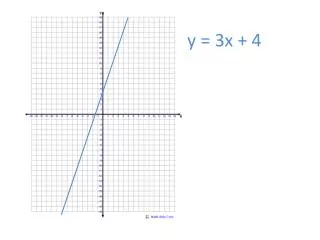
(-1, 1) is where the two lines intersect. • This point is a point on both lines. • Therefore, if we substitute -1 in for x and 1 in for y, we should get a true statement, for both equations.
y = 3x + 4 1 = 3 (-1) + 4 1 = -3 + 4 = 1 2x + y = -1 2(-1)+ 1 = -1 -2 + 1 = -1 -1 = -1
The solution to this system of equations is the POINT where the two lines intersect.
2x + y = -1 2x + y = 7
We cannot see an intersection for these two line. • The lines are parallel. • These two lines have no points in common. • Therefore, there are no values for x and y, that will make both equations true…2x +y cannot equal -1 and 7 simultaneously.
There is NO SOLUTION to this system of equations.
Where do these lines intersect? • They intersect at EVERY POINT!! • These two lines have ALL points in common. • Therefore, every point on either line, is also a point on the other line.
There are INFINITELY MANY SOLUTIONS to this system of equations.
3 Possible Solutions to a System of Equations • Ordered Pair • No Solution • Infinitely Many Solutions The lines intersect at a POINT. The lines are PARALLEL. The equations represent the SAME LINE.