Binary Search Trees
This overview of Binary Search Trees (BST) covers essential concepts in hierarchical data structures. It explains how BSTs work, including their properties and operations such as insertion, deletion, and searching for values. A binary tree's structure allows each node to have at most two children, which facilitates efficient searching. The document illustrates algorithms for inserting and deleting nodes while maintaining the BST property, where left subtrees contain smaller values and right subtrees contain larger values. This resource serves as a foundation for studying more advanced data structures.


Binary Search Trees
E N D
Presentation Transcript
Binary Search Trees Nelson Padua-Perez Chau-Wen Tseng Department of Computer Science University of Maryland, College Park
Overview • Binary trees • Binary search trees • Find • Insert • Delete
Hierarchical Data Structures • One-to-many relationship between elements • Tree • Single parent, multiple children • Binary tree • Tree with 0–2 children per node Tree Binary Tree
Trees • Terminology • Root no predecessor • Leaf no successor • Interior non-leaf • Height distance from root to leaf Root node Height Interior nodes Leaf nodes
Types of Binary Trees • Degenerate – only one child • Balanced – mostly two children • Complete – always two children Degenerate binary tree Balanced binary tree Complete binary tree
Degenerate Height = O(n) for n nodes Similar to linear list Balanced Height = O( log(n) ) for n nodes Useful for searches Binary Trees Properties Degenerate binary tree Balanced binary tree
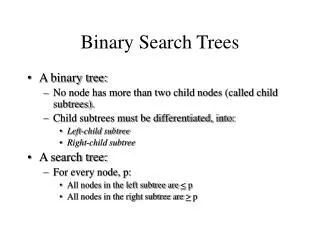
Binary Search Trees • Key property • Value at node • Smaller values in left subtree • Larger values in right subtree • Example • X > Y • X < Z X Y Z
Binary Search Trees • Examples 5 10 10 2 45 5 30 5 45 30 2 25 45 2 25 30 10 25 Binary search trees Non-binary search tree
Binary Tree Implementation Class Node { Value data; Node left, right; // null if empty void insert ( Value data1 ) { … } void delete ( Value data2 ) { … } Node find ( Value data3 ) { … } … }
Polymorphic Binary Tree Implement. Interface Node { Node insert ( Value data1 ) { … } } Class EmptyNode implements Node { Node insert ( Value data1 ) { … } } Class NonEmptyNode implements Node { Value data; Node left, right; // Either Empty or NonEmpty void insert ( Value data1 ) { … } }
Iterative Search of Binary Tree Node Find( Node n, Value key) { while (n != null) { if (n.data == key) // Found it return n; if (n.data > key) // In left subtree n = n.left; else // In right subtree n = n.right; } return null; } Find( root, keyValue );
Recursive Search of Binary Tree Node Find( Node n, Value key) { if (n == null) // Not found return( n ); elseif (n.data == key) // Found it return( n ); else if (n.data > key) // In left subtree return Find( n.left, key ); else // In right subtree return Find( n.right, key ); } Find( root, keyValue );
Example Binary Searches • Find ( 2 ) 5 10 10 > 2, left 5 > 2, left 2 = 2, found 5 > 2, left 2 = 2, found 2 45 5 30 30 2 25 45 10 25
Example Binary Searches • Find ( 25 ) 5 10 10 < 25, right 30 > 25, left 25 = 25, found 5 < 25, right 45 > 25, left 30 > 25, left 10 < 25, right 25 = 25, found 2 45 5 30 30 2 25 45 10 25
Binary Search Properties • Time of search • Proportional to height of tree • Balanced binary tree • O( log(n) ) time • Degenerate tree • O( n ) time • Like searching linked list / unsorted array • Requires • Ability to compare key values
Binary Search Tree Construction • How to build & maintain binary trees? • Insertion • Deletion • Maintain key property (invariant) • Smaller values in left subtree • Larger values in right subtree
Binary Search Tree – Insertion • Algorithm • Perform search for value X • Search will end at node Y (if X not in tree) • If X < Y, insert new leaf X as new left subtree for Y • If X > Y, insert new leaf X as new right subtree for Y • Observations • O( log(n) ) operation for balanced tree • Insertions may unbalance tree
Example Insertion • Insert ( 20 ) 10 10 < 20, right 30 > 20, left 25 > 20, left Insert 20 on left 5 30 2 25 45 20
Binary Search Tree – Deletion • Algorithm • Perform search for value X • If X is a leaf, delete X • Else // must delete internal node a) Replace with largest value Y on left subtree OR smallest value Z on right subtree b) Delete replacement value (Y or Z) from subtree • Observation • O( log(n) ) operation for balanced tree • Deletions may unbalance tree
Example Deletion (Leaf) • Delete ( 25 ) 10 10 10 < 25, right 30 > 25, left 25 = 25, delete 5 30 5 30 2 25 45 2 45
Example Deletion (Internal Node) • Delete ( 10 ) 10 5 5 5 30 5 30 2 30 2 25 45 2 25 45 2 25 45 Replacing 10 with largest value in left subtree Replacing 5 with largest value in left subtree Deleting leaf
Example Deletion (Internal Node) • Delete ( 10 ) 10 25 25 5 30 5 30 5 30 2 25 45 2 25 45 2 45 Replacing 10 with smallest value in right subtree Deleting leaf Resulting tree