Understanding Human Vision: Cone and Rod Function in Photopic and Scotopic Systems
This text explores the complexities of human vision, detailing the two primary visual systems: the photopic system for bright conditions and the scotopic system for dim light. It examines the distribution and function of cone and rod cells in the retina, emphasizing their contributions to spatial resolution and visual sensitivity. The persistence of vision, frame rates in different media, and the eye's adaptation to light intensity are also discussed. The analysis includes a comparison of human vision with camera technology and the implications for visual perception and encoding.


Understanding Human Vision: Cone and Rod Function in Photopic and Scotopic Systems
E N D
Presentation Transcript
Human Vision Nov 15.2012 Wu Pei
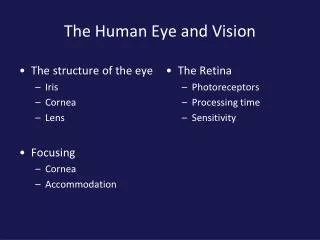
Cone and Rod Vision: • In a sense, each of us has two visual systems; the photopic system functions in lighted conditions; the scoptopic system functions in dim light • Cones mediate photopic vision; rods mediate scotopic vision; this is called the duplexity theory of vision
Spatial resolution • 4.5 million cone cells and 90 million rod cells in the human retina in average. • High resolution in middle and low resolution in edge, highest at fovea, about 1.2'. • Field of view: best resolution horizontal 35°and vertical 20° • In all: 1750*1000 in best resolution zone. About 5-15 megapixel whole field
Qualitative representation of visual detail using a single glance of the eyes.
Time resolution • Persistence of vision: an afterimage is thought to persist for approximately one twenty-fifth of a second on retina. • Fps: frames per second • The mechanism of film system.
Why game need better fps than movie • Movie: 24fps TV: 25fps • Game: 59/60fps
Answer Real video Game
Sensitivity to light • Human eye can is self-adaptive to differed light intensity by adjusting rhodopsin concentration.
Evolutionary perspective • Our vision is optimized for receiving the most abundant spectral radiance our star emits.
Color Depth • True color :8*3=24 bits • HDR: 32*3=96 bits • HDR use float but not fixed point number for luminance ranges from 10-4 to 108 . In practice 10bit to encode luminance and 8bit for hue is enough for eliminating quantization error.
Hints for video coding • Human eye is less sensitive to chrominance signal than to luminance signal (U and V can be coarsely coded) • Human eye is less sensitive to the higher spatial frequency components • Human eye is less sensitive to quantizing distortion at high luminance levels
Estimating bandwidth of eye • Input:24bit*10Mpixel*24fps=720MB/s • Output: ~100kB/s • Compare: H.264,1080p:1.5MB/s
How the visual information encoded • The process of neuron development is a process of “training”.
Encoding and illusion • Illusion means visually perceived images that differ from objective reality. • Generally visual encoding is a lossy coding. So look at the illusion will be helpful to know the encoding process.