Solving Equations Using Addition and Subtraction
120 likes | 272 Views
This educational material focuses on the fundamentals of solving equations using addition and subtraction. The objectives include applying these skills to practical problems and justifying the steps taken in the process. Key concepts such as the Addition and Subtraction Properties of Equality are discussed with illustrative examples. Students will learn how to isolate variables in equations, check their solutions using a graphing calculator, and reinforce their understanding through practice problems. This guide aims to equip learners with essential problem-solving techniques.


Solving Equations Using Addition and Subtraction
E N D
Presentation Transcript
Solving Equations Using Addition and Subtraction Objectives: • A.4f Apply these skills to solve practical problems. • A.4b Justify steps used in solving equations. • Use a graphing calculator to check your solutions.
To Solve an Equation means... • To isolate the variable having a coefficient of 1 on one side of the equation. • Ex: x = 5 is solved for x. • y = 2x - 1 is solved for y.
Addition Property of Equality What it means: For any numbers a, b, and c, if a = b, then a + c = b + c. You can add any number to BOTH sides of an equation and the equation will still hold true.
We all know that 7 = 7. Does 7 + 4 = 7? NO! But 7 + 4 = 7 + 4. The equation is still true if we add 4 to both sides. An easy example: • Would you ever leave the house with only one shoe on? • Would you ever put blush on just one cheek? • Would you ever shave just one side of your face?
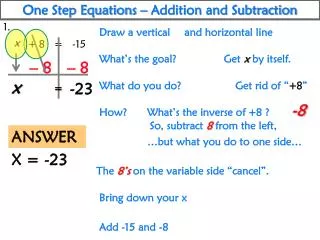
x - 6 = 10 Add 6 to each side. x - 6 = 10 +6 +6 x = 16 Always check your solution!! The original problem is x - 6 = 10. Using the solution x=16, Does 16 - 6 = 10? YES! 10 = 10 and our solution is correct. Let’s try another example!
Recall that y + (-4) = 9 is the same as y - 4 = 9. Now we can use the addition property. y - 4 = 9 +4 +4 y = 13 Check your solution! Does 13 - 4 = 9? YES! 9=9 and our solution is correct. What if we see y + (-4) = 9?
Remember to always use the sign in front of the number. Because 16 is negative, we need to add 16 to both sides. -16 + z = 7 +16 +16 z = 23 Check you solution! Does -16 + 23 = 7? YES! 7 = 7 and our solution is correct. How about -16 + z = 7?
-n - 10 = 5 +10 +10 -n = 15 Do we want -n? NO, we want positive n. If the opposite of n is positive 15, then n must be negative 15. Solution: n = -15 Check your solution! Does -(-15)-10=5? Remember, two negatives = a positive 15 - 10 = 5 so our solution is correct. A trick question...
Subtraction Property of Equality • For any numbers a, b, and c, if a = b, then a - c = b - c. What it means: • You can subtract any number from BOTH sides of an equation and the equation will still hold true.
1) x + 3 = 17 -3 -3 x = 14 Does 14 + 3 = 17? 2) 13 + y = 20 -13 -13 y = 7 Does 13 + 7 = 20? 3) z - (-5) = -13 Change this equation. z + 5 = -13 -5 -5 z = -18 Does -18 -(-5) = -13? -18 + 5 = -13 -13 = -13 YES! 3 Examples: