Download
1 / 5
50 likes | 171 Views
In psycholinguistic experiments, the careful construction of word lists is vital to avoid confounds and ensure accurate results. Factors such as letter length, syntactic category, syllable count, concreteness, imageability, and frequency can significantly influence how subjects respond to words. Understanding the differences among word sets—like "Love, Hate, Justice" vs. "Table, Box, Shoe"—can guide researchers in creating effective stimuli. Databases like the British National Corpus and MRC Psycholinguistic Database offer resources for selecting appropriate words based on specific criteria.

E N D
Generating Word Lists Why would you present word lists in experiments? In developing word lists, and in psycholinguistic experiments in general, the careful construction of your stimuli is absolutely CRUCIAL. What to avoid? CONFOUNDS
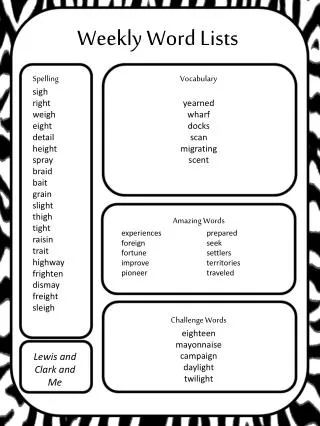
What specific features of words might influence how a subject responds to that word? Ball Train Car Mouse Shop Run Laugh Skip Talk Think What’s the difference between <------ these two sets of words?
Love Hate Justice Freedom Stress Table Box Shoe Cup Pot What differentiates these? <-------- _____________________________________________________ Telephone Industry Operation Catapult Shoe Dog Cat Fun And these? <---------
Words can vary on an almost innumerable set of dimensions Some obvious ones: •letter length •syntactic category •no. of syllables •concreteness •imageability •frequency
Further Information British National Corpus: -100 million word collection of samples of written and spoken language from a wide range of sources, designed to represent a wide cross-section of current British English, both spoken and written. www.natcorp.ox.ac.uk MRC Psycholinguistic Database: -database which allows retrieval of word sets, selected according to wide ranging criteria (e.g., no. of letters, no. of phonemes, no. of syllables, word frequencies, age of acquisition, etc.) www.psych.rl.ac.uk/MRC_Psych_Db.html