Enhancing GRAI Tag Standards for Better Data Management and Asset Tracking
This document outlines the prioritized user requirements and business needs for the development of GRAI tags and their integration with other identification standards like SSCC. It discusses critical areas such as event data content, tag durability, the handling of multiple tags on assets, and the standardization of user memory encoding. Key considerations also include lifecycle management for tags, new process adaptations, and data access timeframes to ensure robust performance in asset tracking and data exchange.

Enhancing GRAI Tag Standards for Better Data Management and Asset Tracking
E N D
Presentation Transcript
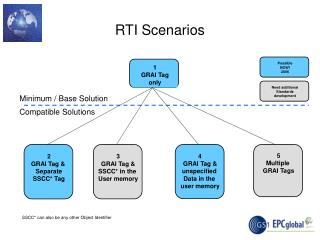
RTI Scenarios Possible NOW! 2006 1 GRAI Tag only Need additional Standards development Minimum / Base Solution Compatible Solutions 5 Multiple GRAI Tags 4 GRAI Tag & unspecified Data in the user memory 2 GRAI Tag & Separate SSCC* Tag 3 GRAI Tag & SSCC* in the User memory SSCC* can also be any other Object Identifier
RTI Prioritised User Requirements High priority:- • Event data content • GRAI Key use • Multiple tags on an asset • Standardization of user memory encoding Further development:- • Tag durability • Multiple level structures • Data access (timeframe)
RTI Business RequirementsOwnership • Tag durability - Technical Steering Group; and performance testing plans • Need to address life cycle of tags (not just a one time use, but possibly for years • Address new processes like washing, etc. • Event data content - Data Exchange JRG • New read points or business locations • New business steps • New object status/disposition • Multiple level structures - Data Exchange JRG • Link “stuff” in object that is not tagged (address use of SSCC) • GRAI key use - Data Exchange & EPCIS WGs • Add GRAI to SGTIN and SSCC key use in data structure
RTI Business RequirementsOwnership • Data access (timeframe) - EPCIS WG • Who gets access to the information about the asset based on the physical receipt • Multiple tags on an asset - Tag Data Standard (TD JRG) • More than one tag on an asset to accommodate durability • Use of the same GRAI vs different GRAIs to determine read performance and durability • Standardization of user memory - Tag Data JRG • Address information to be written to user memory in standardized format (The GRAI or the SSCC or the SGTIN)