Wheelchair Caster Scrub Torque: Key Parameters and Impact on Turning Effort
10 likes | 141 Views
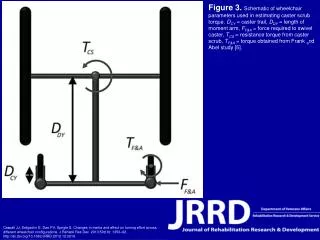
This study explores the parameters involved in estimating caster scrub torque in wheelchairs. Key factors discussed include caster trail (DCY), moment arm length (DDY), the force required for caster swivel (FF&A), and resistance torque due to scrub (TCS). It also references torque findings from Frank and Abel's research (TF&A). The paper by Caspall et al. highlights how changes in inertia affect the turning effort across various wheelchair configurations, providing valuable insights for wheelchair design and rehabilitation efforts.


Wheelchair Caster Scrub Torque: Key Parameters and Impact on Turning Effort
E N D
Presentation Transcript
Figure 3. Schematic of wheelchair parameters used in estimating caster scrub torque. DCY = caster trail, DDY = length of moment arm, FF&A = force required to swivel caster, TCS = resistance torque from caster scrub, TF&A = torque obtained from Frank and Abel study [5]. Caspall JJ, Seligsohn E, Dao PV, Sprigle S. Changes in inertia and effect on turning effort across different wheelchair configurations. J Rehabil Res Dev. 2013;50(10): 1353–62.http://dx.doi.org/10.1682/JRRD.2012.12.0219