Download
1 / 1
10 likes | 117 Views
This work presents a comprehensive atlas of CO shells and associated infrared (IR) bubbles, highlighting their formation and characteristics as identified through intricate observational data. Utilizing Spitzer and radio SNRs, we examine the physical conditions within these shells and their impact on the interstellar medium (ISM). Key findings include detailed properties of specific CO shells, such as G015.68-0.28, and discussions on the gravitational and thermal dynamics involved in their formation. This atlas serves as a critical resource for understanding ISM processes.

E N D
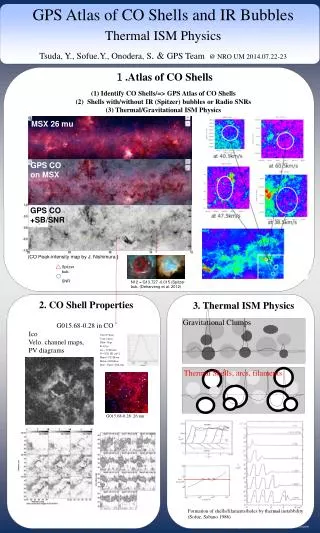
GPS Atlas of CO Shells and IR Bubbles Thermal ISM Physics Tsuda, Y., Sofue.Y., Onodera, S. & GPS Team @ NRO UM 2014.07.22-23 1.Atlas of CO Shells (1) IdentifyCO Shells/=> GPS Atlas of CO Shells (2) Shells with/without IR (Spitzer) bubbles or Radio SNRs (3) Thermal/Gravitational ISM Physics MSX 26 mu GPS CO on MSX GPS CO +SB/SNR (CO Peak-intensity map by J. Nishimura ) Spitzer bub. SNR N12 = G13.727 -0.015 (Spitzer bub. (Deharveng et al. 2012) 2. CO Shell Properties G015.68-0.28 in CO Ico Velo. channel maps, PV diagrams 3. Thermal ISM Physics Gravitational Clumps Vlsr=57 km/s Vsig~2 km/s Dkin~5 kpc R~10 pc Ico ~ 20 K km/s N~4 E21 H2 cm^-2 Mmol~5 E3 Msun Mdyn~4 E3Msun Ekin ~ Egrav~E48 ergs Thermal Shells, arcs, filaments G015.68-0.28 26 mu Formation of shells/filaments/holes by thermal instabbility (Sofue, Sabano 1986)