Rubber Mat Pool 2003
Rubber Mat Pool 2003. Alk = 220 ppm %CO2 = 87.3 %CH4 = 4.7 T =90 C pH = 5.6 Eh = -240 H2S = <100 ppb SO4 = 160 ppm. Rubber mat sample 2003 CSR. Rubber mat sample 2003 CSR peeled layers. Rubber mat sample 2003 CSR. Rubber Mat CSR 03. Jen’s Pool. Experimental (Lipids).
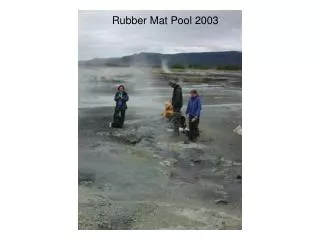

Rubber Mat Pool 2003
E N D
Presentation Transcript
Alk = 220 ppm %CO2 = 87.3 %CH4 = 4.7 T =90 C pH = 5.6 Eh = -240 H2S = <100 ppb SO4 = 160 ppm
Rubber mat sample 2003 CSR peeled layers
Rubber Mat CSR 03 Jen’s Pool
Experimental (Lipids) • at samples were extracted for total lipids, which were fractionated into six lipid classes. • Phospholipid fatty acids (PLFA) were methylated, then quantified using GC-FID. Identifications were based GC retention times of reference standards and GC-MS analysis. • Carbon isotopes were determined on PLFA using GC-IRMS.
Gas Chromatograms of Microbial PLFA Biomarkers 18:26 18:19c 18:1 9t/18:1 7c 16:0 161 9c 10Me18:19c 18:0 i15:0 a15:0
PLFA Biomarkers Arkashin Shaft Rubber Mat CZ#1 North Field Yellow Blue Green (1&2) • 16:0 is the most abundant compound (33-44%), which is universal in all living organisms. • 18:1w7c, 18:1w9c, 18:2w6, 16:1w7c, are also abundant and consistent with biomarkers • characteristic of autotrophic organisms (cyanobacteria, green-sulfur bacteria, and green • non-sulfur bacteria) commonly found in terrestrial hot springs (Zhang et al., 2004). • Biomarkers of heterotrophic bacteria, such as iso- and anteiso-15:0 are low (2-8%). • Results indicate that bacterial biomass production is dominated • by autotrophic organisms in the Kamchatka hot springs. 50 40 30 % 20 10 0 20:0 19:0 cyc a19:0 i19:0 18:0 18:1w7c 18:1w9c 18:2w6 17:0 cyc a17:0 i17:0 16:0 i16:0 16:1w7c 15:0 a15:0 i15:0 fatty acids 14:0 12:0 Zhang, Mills and Romanek
Carbon-Isotope Fractionations Associated with Known Autotrophic Microorganisms [ ] (1000 + d13Cfatty acid) e(‰) = –1 x 1000 (1000 + d13Cbiomass) 15 R-TCA 10 5 FA-Biomass Calvin Cycle 3-HP 0 e -5 -10 Algae Aquificales Green sulfur Green non-sulfur Cyanobacteria
Carbon-Isotope Compositions of PLFA and Total Carbon In Kamchatka Hot Springs FLFA Arkashin Rubber Mat CZ#1 Yellow Blue Green (1&2) i15:0/a15:0 -13.7 -29.8 i16:0 -28.2 a16:0 -25.2 16:1w9c -18.6 -27.9 16:0 -31.1 -17.0 -28.9 -23.1 -15.6 i17:0/a17:0 -29.8 18:2w6 -18.1 -32.1 -22.2 -18.0 18:1w9c -28.7 -17.0 -29.8 -22.2 -16.3 18:1w7c -31.1 -22.2 18:0 -29.3 -21.7 -29.6 -19.1 19:0cyc -30.4 Total PLFA -29.7 ± 1.0 -17.7 ± 2.6 -29.8 ± 1.3 -22.5 ± 0.5 -18.8 ± 3.8 Total Organic C -18.8 -11.38 -25.1 -22.0 -9.8 ePLFA-TOC -11.1 -6.4 -4.7 -0.5 -9.1 Zhang, Mills, and Romanek
Comparison of Carbon-Isotope Fractionations FA-Total carbon e Pure Cultures Kamchatka Mats 15 15 R-TCA 10 10 5 5 FA-Biomass Calvin Cycle 3-HP 0 0 Yellow Blue e CZ#1 North Field -5 -5 Rubber Mat Green (1&2) -10 -10 Arkashin Algae Aquificales Green sulfur Green non-sulfur Cyanobacteria -15 Zhang, Mills, Romanek
East Thermal Field – Rubber Mat Pool? K33 K45 K73 K61 K48 C. Weber and G. King
CO UPTAKE BY MICROBIAL MATS ALONG A THERMAL GRADIENT East Thermal Field C. Weber and G. King
Site: K48 Temperature: 48 ºC pH: 6.5 Weber and King
Site: K45 Temperature: 45 ºC C. Weber and G. King
Cloning & sequence Rbcl gene Subunit rubisCO enzyme 1C Group Obligate Lithotrophs 1A Group Faculative Lithotrophs C. Weber and G. King