Unraveling Genetics: A Journey Through Heredity and Evolution
140 likes | 328 Views
This engaging introduction to genetics explores the fascinating science of heredity—the transfer of traits from parents to offspring. Dive into topics such as genetic variation, genes, alleles, and the complexities of skin color influenced by melanin. Learn about the historical development of genetics, from ancient practices to groundbreaking discoveries by pioneers like Gregor Mendel and Charles Darwin. This framework is essential for understanding evolution and the modern implications of genetic study. Join us in this motivational journey through the world of genetics!


Unraveling Genetics: A Journey Through Heredity and Evolution
E N D
Presentation Transcript
Genetics: An Introduction Biology 12
A little motivational video: http://www.youtube.com/watch?v=B_PQ8qYtUL0
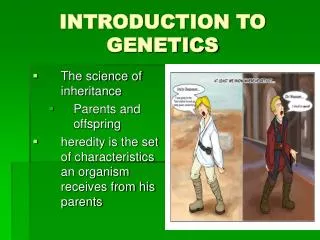
What is Genetics? • The science that studies heredity • Heredity is the passing of traits from parents to offspring
Variation: • Genetic variation describes naturally occurring genetic differences among individuals of the same species • Why? • Recombination of chromosomes that occurs during sexual reproduction (called independent assortment) • Crossing over during meiosis
Some vocabulary: • Genes • Humans have ~21,500 • Chemical instructions for building proteins • Locus/loci:specific location on a chromosome • Diploid cells contain two copies of each gene on pairs of homologous chromosomes • Allele: each version of a gene
Video: ABC News: All in the family: Mixed race twins http://abcnews.go.com/Health/twins-white-black-born-biracial-parents-stirs-issues/story?id=12984334
The color of skin is genetically very complicated! • Skin color comes from the pigment melanin • Produced by melanocytes in skin cells • More than 100 genes directly or indirectly influence amount of melanin in an individual’s skin • Lead to many variations in skin color
History of Genetics • People have known about inheritance for a long time. • children resemble their parents • domestication of animals and plants, selective breeding for good characteristics • Sumerian horse breeding records • Egyptian data palm breeding
Mid 1800’s Discoveries • Major events in the mid-1800’s led directly to the development of modern genetics. • 1859: Charles Darwin publishes The Origin of Species, which describes the theory of evolution by natural selection. This theory requires heredity to work. • 1866: Gregor Mendel publishes Experiments in Plant Hybridization, which lays out the basic theory of genetics. It is widely ignored until 1900.
History of Genetics: • Pioneer of Genetics: Gregor Mendel • Born in 1822 in Czechoslovakia. • Became a monk at a monastery in 1843. • Taught biology and had interests in statistics. • Also studied at the University of Vienna
Major Events in the 20th Century • 1900: rediscovery of Mendel’s work by Robert Correns, Hugo de Vries, and Erich von Tschermak . • 1904: Gregory Bateson discovers linkage between genes. Also coins the word “genetics”. • 1910: Thomas Hunt Morgan proves that genes are located on the chromosomes (using Drosophila). • 1944: Oswald Avery, Colin MacLeod and Maclyn McCarty show that DNA can transform bacteria, demonstrating that DNA is the hereditary material. • 1953: James Watson and Francis Crick determine the structure of the DNA molecule, which leads directly to knowledge of how it replicates • 1966: Marshall Nirenberg solves the genetic code, showing that 3 DNA bases code for one amino acid. • 1972: Stanley Cohen and Herbert Boyer combine DNA from two different species in vitro, then transform it into bacterial cells: first DNA cloning. • 2001: Sequence of the entire human genome is announced.
To do : Read pages 130 and 131. Read Mendel biography articles and answer the questions at the bottom based on both readings!