Download
1 / 15
150 likes | 275 Views
This article explores the various constraints that limit adaptation in evolutionary processes. It delves into functional, physiological, developmental, and genetic constraints, highlighting examples like Darwin's finches and the unique adaptations of pandas. By examining the trade-offs imposed by limited resources and genetic correlations, we gain insight into why certain traits may not evolve as expected. The piece also discusses the concept of exaptation and how traits can serve new functions despite their original evolutionary purpose, reinforcing the complexity of evolutionary dynamics.

E N D
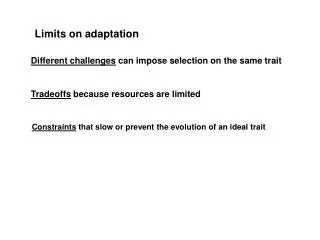
Limits on adaptation Different challenges can impose selection on the same trait Tradeoffs because resources are limited Constraints that slow or prevent the evolution of an ideal trait
Limits on adaptation Constraints – factors that slow or prevent the evolution of an ideal trait Functional constraints ex: Darwin’s finches with large beaks can’t sing complex songs
Limits on adaptation Constraints – factors that slow or prevent the evolution of an ideal trait Functional constraints ex: Darwin’s finches with large beaks can’t sing complex songs Physiological constraints Why isn’t this flower dropped after pollination? find the answer in your textbook!
Limits on adaptation Constraints – factors that slow or prevent the evolution of an ideal trait Functional constraints ex: Darwin’s finches with large beaks can’t sing complex songs Physiological constraints Why isn’t the flower dropped after pollination? Developmental constraints ex: panda’s fifth digit can’t be used to manipulate bamboo
Limits on adaptation Constraints – factors that slow or prevent the evolution of an ideal trait Functional constraints ex: Darwin’s finches with large beaks can’t sing complex songs Physiological constraints Why isn’t the flower dropped after pollination? Developmental constraints ex: panda’s fifth digit can’t be used to manipulate bamboo Genetic constraints genetic correlation between two traits can prevent adaptation of both
Limits on adaptation Constraints – factors that slow or prevent the evolution of an ideal trait Functional constraints ex: Darwin’s finches with large beaks can’t sing complex songs Physiological constraints Why isn’t the flower dropped after pollination? Developmental constraints ex: panda’s fifth digit can’t be used to manipulate bamboo Genetic constraints genetic correlation between two traits may prevent one trait Lack of genetic variation (including lack of a preadaptation) ex: ability to feed on new host plants (text)
Limits on adaptation Constraints – factors that slow or prevent the evolution of an ideal trait Functional constraints ex: Darwin’s finches with large beaks can’t sing complex songs Physiological constraints Why isn’t the flower dropped after pollination? Developmental constraints ex: panda’s fifth digit can’t be used to manipulate bamboo Genetic constraints genetic correlation between two traits may prevent one trait Lack of genetic variation (including lack of a preadaptation) exaptation (preadaptation) – trait that increases fitness through a particular function, but has not evolved for that function; an existing trait that is used for a new function
Limits on adaptation Constraints – factors that slow or prevent the evolution of an ideal trait Functional constraints ex: Darwin’s finches with large beaks can’t sing complex songs Physiological constraints Why isn’t the flower dropped after pollination? Developmental constraints ex: panda’s fifth digit can’t be used to manipulate bamboo Genetic constraints genetic correlation between two traits may prevent one trait Lack of genetic variation (including lack of a preadaptation) Could the tetrapods have evolved to use the stapes (ear bone) for hearing if they had not lost their gills? read about the evolution of the ear and see what you think!
Variations on natural selection Sexual selection– selection via differences in mating success What happens when selection acts differently on a trait in males and females? Life history evolution– What happens when selection acts differently on a trait during different portions of the life cycle? offspring produced at each age RS cumulative fitness future fitness 0 1 2 3 4 5 6 7 8 expression of lethal mutation age
Variations on natural selection Phenotypic plasticity– genotype expressed differently in different environments
Variations on natural selection Phenotypic plasticity can evolve if: heritable under selection Genetic variation in phenotypic plasticity leaf size shade sun plasticity Which families are favored in sun? in shade? in env. with both? 1 2 3 4 5 6 7 8 9 family
Variations on natural selection Phenotypic plasticity can evolve if: heritable under selection Genetic variation in phenotypic plasticity Is there VP? variation among all dots Is there VG? variation among family means Is there VE? variation btwn sun & shade means leaf size 1 2 3 4 5 6 7 8 9 family
Variations on natural selection Phenotypic plasticity can evolve if: heritable under selection Genetic variation in phenotypic plasticity Is there VP? Is there VG? Is there VE? What accounts for variation in plasticity? VG x E leaf size 1 2 3 4 5 6 7 8 9 family
VP = VG + VE + VG x E parent is alcoholic parent is not alcoholic env 1 env 1 env 1 env 2 env 2 env 2 Variations on natural selection Phenotypic plasticity can evolve genotype x environment interaction purely genetic purely environmental actual % alc- oholic
VP = VG + VE + VG x E parent is alcoholic parent is not alcoholic env 1 env 1 env 1 env 2 env 2 env 2 Variations on natural selection Phenotypic plasticity can evolve genotype x environment interaction purely genetic purely environmental actual % alc- oholic